Pages

Showing posts with label winter. Show all posts

Wednesday, December 3, 2014

Harriet the Hairy Woodpecker

An early snowfall has flocked the garden in frost and snow, and subfreezing temperatures have kept it that way.

The path that leads to a nearby pond, which was squishy and slippery with wet leaves just two weeks ago, now crunches underfoot as if one were walking on thin panes of glass. Branches bristle with small spears of ice in strange shapes.

The cold and ice make it harder for birds to find food and stay warm (despite their being well adapted to life in this climate or they wouldn't be living here in the first place), so we make sure the seed and suet feeders are well stocked. Every morning we bring in the hummingbird feeder that's frozen overnight and replace it with a fresh one, under the imperious gaze of the Anna's hummingbird hovering nearby like an impatient customer waiting for the waiter to clear a table in a crowded brunch spot.

Though I hate winter, I have to admit it's a great season for backyard birding. Birds that were hidden by leaves and more often heard than seen are now easily spotted. They'd be hard to miss even if they didn't come close to the house to access the feeders. I rarely see the calico Varied Thrushes or the rusty Fox Sparrows in other seasons.

So it was a wonderful surprise to glance out the window the other morning and find a new species at the feeder: a big female Hairy Woodpecker, chiseling away at the suet with her sturdy beak.

Hairy Woodpeckers are a common species, found throughout North America and into Central America. They look like a supersized version of the Downy Woodpecker. The little Downy Woodpeckers are far more likely to turn up in a garden, because Hairy Woodpeckers are more at home in deep, mature forests. 

In winter, however, Hairy Woodpeckers will venture out of their comfort zone and make forays into parks and gardens. Our home is close to a conservation area thick with trees as well as scattered areas of deciduous woodlands and remnants of coniferous forest, and the cold snap drove this one to forage a little farther than she usually does.

It's easy to tell that this one is a female because she doesn't have a red patch on the back of her head like the male does. As for distinguishing a Downy from a Hairy, size is the first clue (the Hairy is a third bigger than the Downy and weighs about three times as much). The Hairy's stout bill is about as long as its head; the Downy has a tiny bill. And, if you're close enough to the bird or have good binoculars, you can see that the Hairy's outer tail feathers don't have spots like the Downy's. Except, of course, when they do. Some populations have spots on those feathers. Tricksy birds.
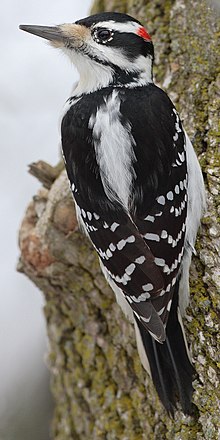
Picoides-villosus-001.jpg
Wikimedia Commons photo
I have always wondered, though, just why this attractive bird has a name like Hairy Woodpecker. It doesn't look any hairier to me than any other bird, and certainly isn't a shaggy mop compared to the Downy, which likewise doesn't look particularly downy. 

According to Dictionary of Birds of the United States by Joel Ellis Holloway, the Hairy Woodpecker's scientific name, Picoides villosus, translates to "hairy" or "shaggy" woodpecker and is a reference to "the bristles covering the nostrils." The Downy's scientific name, Picoides pubescens, translates to "downy woodpecker" and also refers to the nasal bristles, "which are shorter and appear softer than those of the hairy woodpecker."

I ask you. WHO NAMES A BIRD LIKE THIS AFTER NOSE HAIRS?

OK, technically they're not nose hairs. They're rictal bristles. But still. As we said sarcastically in the early 1970s, thinking we were very clever, "Same difference." 

Well, perhaps after naming all those red-headed and ladder-backed woodpeckers, there wasn't much left in the nomenclature bank to dispense on these striking birds. 

For a few minutes while researching this bird, I thought I had stumbled upon a possible bit of backwards induction in its naming when I learned that one outdated common name for this species is "Harry," and that various Pacific subspecies of Hairy Woodpeckers are grouped under the name Picoides villosus harrisi--with the harrisi stemming from an old name for one of these birds, Harris's Woodpecker. 

The Harris in question is Edward Harris, an amateur ornithologist who was a friend of Audubon's and accompanied him on some of his travels. (Harris's Hawk and Harris's Sparrow are also named for him.) Was "Hairy" a corruption of "Harry"? (That still wouldn't explain the Downy, unless it was named Downy by default in comparison to the Hairy...) 

Alas, no. Audubon wrote at length about both Hairy and Downy woodpeckers and took note of the bristles, describing how the bird had "a large tuft of reversed stiffish feathers on each side of the base of the upper mandible, concealing the nostrils; the feathers in the angle of the lower mandible also stiffish, elongated, and directed forward."

He even observed them while hanging out with the aforementioned Harris: "I have found this species, when in company with my friend Harris and my youngest son, in the very midst of vast salt-marshes, about the mouths of the Mississippi, where here and there a straggling willow or cotton-tree bush occurred, as gay, busy, noisy, and contented as if it had been in the midst of the woods."

Of course, these poor birds might not have been so gay, busy, noisy and contented if they knew that Audubon and his friends were likely to blast them with shotguns. Notes Audubon of this species, "it clings, when shot, to the trunk or branch of the tree, until quite dead, and even remains sticking for several minutes more." 

I realize Audubon's shooting sprees added a lot to our storehouse of ornithological knowledge, but it can be unsettling reading his descriptions of plugging away at the poor birds. 

Modern scientists aren't quite so gun-happy, though birds still meet their maker in the name of Science. How else would we know that as many as 100 nasty little wood-borers may be found in the stomach of a single Hairy Woodpecker? It's certainly doing its bit to keep its forest home healthy, gobbling up insects and their larvae. 

An equally cool statistic (provided by a living bird, this time) is that it can drum on a tree 25 times in the span of one second. We'll be listening for that later this winter; the woodpeckers will be forming the percussion section for the symphony of springtime by then, just as the male Anna's hummingbirds defy winter with their exuberant courtship displays.


Sunday, December 22, 2013

Solstice Rambles

It has been a long and emotionally wrenching year. Our most fervent hope is that, just as the shortest day of the year comes to a close and the hours of daylight gradually increase, life follows suit and brightens a bit more each week.

With that thought in mind, we decided to chuck all responsibilities while the Resident Teen was out of town with a friend's family, enjoying a snowy getaway up near the border, and just go wandering in our new neck of the woods.

But you know what they say about mice and their best laid plans. At first, Things Were Not Cooperating. We'd planned to center our outing on a visit to Sliders Cafe in Carnation, where Tony would bring his banjo and enjoy a bluegrass jam.

However, this goal was thwarted by the fact that, despite a chock-full calendar of events on the cafe's website, the forbidding news that it was closing down (which we'd learned a few weeks ago) came true, and instead of the bluegrass jam, yesterday was actually the Big Move-Out Day. Showing up with a banjo would've been just silly.

We decided to haul the dog with us and go for a walk in the Carnation area anyway, though I think partly the resident Banjo Player wanted to see for himself that Sliders actually was closed. Driving past the darkened building without a name on it anymore was a pretty good clue that it was.

"Hey, why don't we go to Remlinger Farms and get a pie for later?" suggested the disappointed musician. So we headed east, driving a route we took many times when the Resident Teen was a little one and a farm park with ponies, old-fashioned sweet rides, a fire truck to climb on, and baby goats to pet--with the promise of an ice cream cone before going home--was all that happiness required.

We knew the park would be closed, but thought perhaps the big produce and gift store would be open. We were wrong. No pie for us.

Well, at least we could go for a walk. Or could we? The first two pull-outs on the main road demanded that we have a Discover Pass to park there and set foot on the trail. Lacking said pass, we pushed farther south. And there we discovered a little gem that made all the dead-ends worth while: Tolt Macdonald Park and Campground.

The dog bounded out of the car (as much as she could bound with a leash around her neck) and nearly hyperventilated snuffing up all the rich new smells as we followed a path along the Tolt River. The river, roaring thunderously, galloped along like a herd of mustangs.


We hadn't walked for five minutes before we  heard the creaking cry of a bald eagle. It settled in a tree just ahead of us on the trail.

Across the river, its mate perched  near the enormous nest the two had maintained for years. Another walker told us they'd raised an eaglet there last year and she'd come every day to see the story unfold.

Another bit of walking took us to a curve in the trail where the Tolt joined forces with the Snoqualmie River. A suspension bridge over the roiling waters led to a lush green campground complete with yurts.

A cheerful sign warned us of the usual dangers to expect (oh, you know, little things like cougars and bears), but the only perils present were a pair of off-leash Doberman pinschers. I think Luna would've preferred the cougars and bears to the investigation she got from the Dobies.

As it was, she didn't appreciate walking across slats and having to spread her webbed Labrador toes wide, so she carefully walked like a trapeze artist on the little wooden "sidewalk" that ran down the middle of the bridge to facilitate rolling wheelbarrows full of camping gear across the river.

Finally, the low-lying white strips of cloud sank to ground level, creating that particularly Northwest variety of snow-globe-style drizzle.

Wet and muddy, we returned to the car, drove home, tidied up, and went out again, this time to Willows Lodge for an evening by a roaring fire complete with a glass of wine, a plate of antipasti, and thumping good music played by a young acoustic guitarist and his drum-playing friend. Christmas lights twinkled inside and out, laughing at the darkness of the longest night.


Tuesday, December 10, 2013

Winter Walks, Cottage Lake

"17 degrees," read the dashboard thermometer in the car, which meant the street surface a few feet down from that thermometer was actually several degrees colder.

A morning made for black ice, and indeed many road signs in the area warn "Watch for ice."

A mass of Arctic air lumbering into the Puget Sound region this past week brought the first killing frost along with the icy roads and encrusted windshields.

White crystals have outlined leaves and blades of grass in shady spots, fooling one into thinking it's snowed.

Before the cold snap hit, I took a walk to Bassett Pond to take in the lovely hay-and-smoke coloring of the leafless branches and the beauty of the white-trunked birches with their tracery of dark twigs. A few days later, the pond had frozen over and the last of the bright green mosses and ferns had faded into mushy clumps.


 Strands of Methuselah's Beard Lichen (tentative identification)

Bracken, already brown and crisp while many native ferns are still glossy green

Bassett Pond, late November

Bassett Pond, late November

A blaze of redtwig dogwoods  

Labradorus woofus in its natural habitat 

Fungus called Witch's Butter with moss


Bassett Pond, frozen

Close-up of frozen pond and its contents

Thursday, October 31, 2013

Woolly Logic, Caterpillar Division

We found this guy on a path in Marymoor Park, Redmond, WA.
Just in time for Halloween, here's a caterpillar that dresses up as a tiger but is known as a woolly bear.

Woolly bears are found throughout North America, except in the most northern latitudes. They're one of the most familiar and well-liked caterpillars; it was fondly called a woolly bear even back in Colonial times. (Southerners, however, call them "woolly worms.") Thanks to its fuzz, this larva enjoys an affection not granted to its bare green and brown cousins.

Part of a woolly bear's appeal must also spring from its dogged caterpillar-on-a-mission behavior. Woolly bears catch our eye in autumn because that's when they trundle across sidewalks, paths, and roads, seriously boring ahead as if bearing important messages that must be delivered as soon as possible.

This woolly bear's curled-up self-defense certainly
dissuaded me from devouring it.
Nothing distracts a woolly bear from its task.

If you pick it up, it will coil tightly, under the assumption that you are a bird who wants to eat it but will give up once its potential meal turns into an unappetizing burl of bristles.

It will stay curled up until it figures the coast is clear, then will abruptly straighten out and resume its determined trek.

What these busy caterpillars are actually doing is looking for a safe place to hide for the winter. A woolly bear spends the cold months curled up under bark or tucked among rocks or logs. Its entire body shuts down, even its circulatory system. A natural antifreeze permeates its tissues, protecting it from damage in freezing temperatures.

Adult tiger moth, Wikipedia
In spring, the caterpillar emerges from this hibernation to spin a silken cocoon, shedding its bristles and incorporating them into the fabric, too. From this cocoon emerges the "tiger": a golden Isabella Tiger Moth.

The moth quickly finds a mate and lays eggs. In most of its range, this species hatches out into a spring generation of caterpillars that chow down on herbaceous plants (wild species, not garden plants or crops--probably another reason it's so well liked).

The spring generation then pupates, ultimately hatching into a second generation of moths that produces a second batch of caterpillars.

It's these summer caterpillars that chug across paths in fall, grabbing our attention with their cinnamon-and-black-velvet cloaks. They're also responsible for inspiring a charming bit of folklore: the width of a woolly bear's brown band is said to predict the severity of the upcoming winter. A wide band foretells a mild winter, while a narrow band warns of a harsh season ahead.

There's no scientific basis for this belief; studies haven't revealed any correlation between band width and weather. How much brown is on a caterpillar has more to do with its age: older caterpillars have wider brown bands. Caterpillars that feed in regions where fall weather has been damp tend to have narrower brown bands than caterpillars that frolicked in dry regions.

This woolly bear is not a woolly bear.
One of the first attempts at sussing out the relationship between bristles and blizzards took place in the 1940s and 1950s, when an entomologist named C.H. Curran spent some time collecting woolly bears, measuring their bands, and calculating the average.

According to the Old Farmer's Almanac, Curran was simply larking about while enjoying an excuse to take in the beauty of fall foliage in the Bear Mountain area of New York, knowing his sample sizes were too small to yield useful data. He, his wife, and his friends dubbed themselves "The Original Society of the Friends of the Woolly Bear." Apparently his caterpillars boasted relatively broad brown bands in those years, which were marked by winters that were milder than usual, confirming that the folklore was true in many people's estimations.

Of course, nothing (least of all scientific proof) will stop people from believing what they want to believe. Especially when it involves furry caterpillars. In some places it's thought that not only does the degree of brown banding foretell winter weather--the direction of caterpillar travel is a clue, too. A southbound caterpillar is telling you winter will be terrible, while a northbound one believes that winter will be mild. (That would mean peregrinations precisely prognosticate precipitation.)

"I'm heading south. No! North! No...wait..."
Although woolly bears are probably no better than TV meteorologists at predicting the weather, they're apparently aces at balancing their intake of toxic substances to rid themselves of parasites.

 A recent study showed that woolly bears infected with fly larvae (which rudely devour their host as they grow) increase their consumption of alkaloid-containing leaves, which kills off their unwanted guests.

If you just can't get enough of woolly bears, you can find woolly-bear festivals, complete with costume contests, woolly-bear races, and weather predicting, in several towns nationwide, including Vermilion, Ohio; Banner Elk, North Carolina; Beattyville, Kentucky; Lewisburg, Pennsylvania; and Oil City, Pennsylvania. Or start your own Society of the Friends of the Woolly Bear.


Monday, January 14, 2013

The Snowy Owl of Ballard

Snowy owls silently swept south into Seattle again this winter.

(c) Pat Gaines/Creative Commons
On whispering white wings, the owls beat their way from the Arctic tundra in search of food, their flight muffled by feathery fringes that dampen sound. Here they perch on roofs and in trees, at airports and on beaches, keeping their counsel.

One of these owls has taken up residence in Ballard near Sunset Hill Park, a small patch of green with a sweeping view of Puget Sound and the Olympics. She perches in a tall Douglas-fir on some days, atop chimneys or roof slopes on others.

From this commanding position, she employs the "sit and wait" hunting technique of her kind, surveying her realm for the slightest movement of possible prey.

"She" has been identified as most likely being a young female due to the extensive dark-brown markings in her plumage. Young snowies are more heavily barred and spotted than older owls in general, but immature males tend to have paler markings than females and more of a white bib; females' brown markings can also be so dark as to appear black. According to the Cornell Lab of Ornithology, "any Snowy that looks nearly black and white is probably a female."

(c) Claire Thornburgh, used with kind permission
(Yes, Harry Potter fans, that means that Harry's owl Hedwig, at least in the movies, was actually a male [really three males, named Gizmo, Ook, and Sprout]. It's the males that grow up to have pure white plumage faintly marked with brown. The female owl, however, is bigger.)

Last year, I never got to see the owls who landed in Seattle as part of a nationwide irruption of snowies (an irruption that resulted in a snowy owl showing up in Hawaii for the first time ever).

I wasn't going to miss my chance this year, so I made sure to pop over to Sunset Hill Park several times.

I finally got lucky on one of those visits after learning that the thing to do was not to visit the park and look for an owl, but rather to drive up the street and look for the gaggle of people with telescopes and camera lenses aimed at the owl and join them.

That's when I saw her in all her chiaroscuro splendor, sitting calmly in an evergreen, dozing. Her closed eyes curved like crescent moons, making her look as if she were enjoying a quiet laugh. Occasionally she stirred and her eyes winked open, revealing the yellow full-moons behind her lids as she swiftly swiveled her head.

Irruptions of snowy owls typically occur every few years in response to cyclical fluctuations of lemming populations in the Arctic. If snowy owls had school cafeterias, lemmings would be their tater tots. These rodents form the bulk of their diet, and it's estimated that a typical snowy eats about 1,600 of them a year.

In lean years, when lemming populations are down (a result of lemmings gobbling up all the vegetation in boom years and then having to pay the piper, ecologically speaking), immature snowy owls are crowded off the  hunting grounds by older, dominant owls who claim the available territory. Hence the younger owls' nomadic forays into other climes.

Snowies aren't limited to lemmings, so they're not fussed about eating other foods in lemming-less lands. On the tundra, they also catch arctic hares, mice, ptarmigan, waterfowl, and even fish. (Indeed, its Swedish name is Harfang, which means "the owl that catches hares.") Elsewhere, they can subsist on a diet of ducks, gulls, rabbits, crows, rats, moles, and squirrels. They're not above scavenging roadkill, either.

(c) Petr Kratochvil/Public Domain Photos
Despite their size (about 2 feet long, with a 5-foot wingspan and a weight of up to 6 pounds), snowy owls move quickly--and the crows that sometimes mob Seattle's visitors are advised to keep their distance even from an owl that appears to be fast asleep. The 1936 tome Birds of America notes in its entry on the snowy owl that if a crow comes too close, "the ghost suddenly launches out on strong, silent wings, the great talons strike and close, and there is a Crow who would have been the wiser but for the circumstance that he is very dead."


The appearance of these ghostly birds far south of their usual winter range is nothing new. Native American peoples were familiar with the arrival of snowies and had their own speculations about why the white owls appeared. According to a  January 1965 article in The Milwaukee Journal about the deadly Blizzard of 1886, survivors of that storm recalled the "omen of the snowy owls. All through a warm autumn they came, ghosting through fog to roost in tall cottonwoods along the river. Indians warned settlers to expect bad weather, but few paid attention."

John James Audubon, writing more than a century before Alaska became part of the United States, knew about snowy owl irruption, too. He pointed out that "This beautiful bird is merely a winter visitor of the United States, where it is seldom seen before the month of November, and whence it retires as early as the beginning of February." He himself saw snowies in Kentucky and Ohio and notes that others popped up in Pennsylvania and New Jersey.

An 1887 "Cyclopedia of Natural History" recounts the circumpolar species' irruptions overseas. Snowy owls there are known for "occasionally straggling in winter to the British Islands, various parts of Central Europe, South Siberia, Mongolia."

The book's author was aware of North American irruptions, too, commenting that "Sometimes there is a large flight of them along the seacoast, so much of a one indeed that the fact is duly heralded in the local newspapers." In this respect, neither the owls' behavior nor that of newspapers has changed one whit.

Fortunately (despite the shooting of the wayward bird that landed in Hawaii), the snowy owls' reception has changed, thanks to laws that protect our native birds. Writing in the 1920s, naturalist William Dawson lamented that during an irruption "No opportunity is ever lost of killing one of these handsome midwinter visitors; and one might suppose, from the number of specimens which adorn store windows and taxidermists' shops, that the bird is much more common than it really is."

(c) Claire Thornburgh, used with kind permission
Sighting a snowy owl is not the only reward for visiting the Sunset Hill Park on a crunchy, cold, clear-sky winter day. The day I stopped by, I also saw an Anna's hummingbird buzzing in a bare treetop farther down the slope.

Few places, I imagine, offer a chance to see one of the world's smallest birds--a subtropical species that's expanded its winter range northward thanks to an abundance of feeders and nectar-rich exotic garden plants--with one of the world's largest owls, who's migrated southward from a land of ice and snow and not quite enough lemmings.

The hummingbirds are already starting their courtship and will soon be nesting. Some will be feeding nestlings by the end of February, by which time the snowies will have headed back to the tundra to start their own families.


Saturday, January 12, 2013

Cold Nights, Hot Dishes, & One New Recipe a Week

Temperatures have dipped below freezing for the past few days. The car locks are frozen solid in the morning. Every leaf and grass blade is fringed with white. The Anna's hummingbird who rules the side garden perches in the bare plum tree, waiting for me to blow-dry the frozen sugar-water-filled feeder so he can have his breakfast.

These are fine days to stay inside and make good on a New Year's resolution to cook at least one new recipe each week.

The kitchen shelves creak under the weight of yards of cookbooks and bins of recipes clipped from magazines even though, week in, week out, I tend to plonk down the same routine of pasta and sauce, meatloaf, macaroni and cheese, hastily tossed-together stir-fries, and roasted chicken with rice and broccoli.

Not that it's a bad routine, but those cookbooks are looking sort of resentful and making me feel kind of guilty.

So: the first week of 2013's new recipe was...roasted chicken.

But not just the usual "throw in oven, turn up heat, cook til done" roasted chicken I usually make. I took the time to brine two chickens and roast them according to the instructions in the America's Test Kitchen Family Cookbook.

The friends we'd invited for dinner brought the side dishes (spinach salad, couscous with cranberries).

Having guests--a rather rare event, sad to say--inspired the try-out of a second new recipe: a dessert of Apple Bundt Cake, taken from the pages of Bundt Cake Bliss by Susanna Short. Served with powdered sugar and a dollop of fresh whipped cream on top, it tasted what like living inside an apple tart might be like. Which I mean to sound like a good thing.

This week's freezing weather has been offset by roasting pork loin, again using the brine-and-roast method from the Family Cookbook, which yields a succulent roast that cozies up nicely with red cabbage, egg noodles, and peas.

Sadly, there's no bundt cake to round out this meal. After all, there's that other pesky New Year's resolution--the one having to do with getting in shape--to uphold.

Tuesday, December 11, 2012

Winter and Summer Mix It Up

A honeybee at the nursery in December, out of season.
We humans, huddled inside parkas and scarves and mittens, know full well that it's winter here in the Puget Sound area. (All humans younger than 10 and older than 18, that is. In between exist primates who, for reasons of youthful vigor or fashion, seem impervious to cold and rain--or pretend that they are--and go about in tee shirts and tiny skirts and cute but useless puffy vests.) It is raw and gray most days, with rain either threatening, spitting, or bucketing down.

Calendula in bloom
But after a hot, dry summer that extended well into fall, some of the plants and a handful of insects don't seem to have gotten the message that winter's here.

In just the past two weeks I've seen cosmos plants--those blowsy butterflies of summer--still clinging stubbornly to their blossoms. The geranium out front continues to pump out half-hearted flowers, and a crocosmia in the back garden only just gave up the fight. A cherry tree on one of my walking routes has popped open dozens of blooms, and calendulas are shining like supernovae.

Go to sleep, already!

At the same time, those plants that typically brighten up a dim winter day are flaunting their colors. With those Anna's hummingbirds that somehow manage to survive this far north zipping around and singing squeakily, it would feel downright tropical around here if it weren't for the mercury dropping.

Beautyberry

Leaves of creeping geranium species

Fruits of strawberry tree

Tuesday, January 31, 2012

Summer's Hummers Are Winter's Glitter

Why it has taken me two decades to put up a hummingbird feeder, I cannot say. Miniature birds cloaked in dazzling jewel tones buzzing around like radio-controlled helicopters outside the living room window go a long way toward livening up a gray Northwest winter day.

It never ceases to amaze me that such a tiny puff of life can survive this far north in winter.

Seattle’s maritime climate generally soaks us in drizzle, mist, rain, fog, and all-purpose grayness for most of the winter (and a good chunk of autumn and spring)—not exactly the lush, warm paradise you’d envision for a hummingbird. Throw in a few subfreezing cold snaps and snowstorms, and you’d think the hummingbirds were goners for sure.

Instead, here we are, lingering over coffee, watching this iridescent creature sipping sugar water as snowflakes buffet its thumb-sized body.

When the female (at right) visits, she typically perches, feeds, then flies away. The male, however, tends to hang around between meals.

On this snowy morning, he alternated sips with perching on a limb of the red-twig dogwood, where he sat shaking his head, fanning his tail, and flicking his wings to shrug off snowflakes. It was hard to tell if the flakes were irritating him or if he was enjoying a shower—the actions were so much like those of a rufous hummingbird I’d seen bathing in a fountain last summer.


When he took refuge under the birdbath, however, it was clear that he wasn’t charmed by the snowflakes.


The sugar solution in the feeder (a standard 4 parts water/1 part sugar confection boiled, then cooled) stayed liquid until the temperature hit 29 degrees, at which point we brought it indoors to thaw.

While it was gone, the hummingbird continued to visit, hovering in the spot where the feeder normally hangs. He pirouetted around the empty space, as if the feeder would magically appear if only he viewed it from the right angle, forming question marks in the air with his flight patterns.

An awful image entered our minds at the thought of hummingbirds attempting to sip from a frozen feeder—an avian version of the tongue-frozen-to-a-pole scene from A Christmas Story.

Fortunately, “hummingbird tongue freezing” does not seem to be a problem recorded in the halls of birdlore, though some hummer fans sound an alarm about purported “perch hypothermia.”

("Perch hypothermia" is a supposed syndrome in which hummingbirds topple from perches after feeding on cold sugar solution, which supposedly wouldn’t happen if they hovered in front of the fake red flowers instead. I can’t help but feel there’s a strand of Protestant-work-ethic at work here: “Encouraging hummingbirds to be lazy and sit on perches is the work of the devil”).

Our visitor, by the way, is specifically an Anna’s hummingbird, a species that has expanded its winter range over the past 50 years. My decades-old Audubon bird encyclopedia notes that the Anna’s is the only hummingbird to winter in the United States and that it only nests in California; both statements are now false.

Hummers of other species, for example, are now known to winter in the southeastern states. The existence of exotic flowers in gardens as well as hummingbird feeders is reputed to have aided and abetted the expansion of hummers’ ranges, though it’s likely that other factors are driving it, too, and the increased presence of the hummers no doubt inspires the setting-out of feeders.

As for the Anna’s (which now ranges as far north as British Columbia), it even starts courting, nesting, and laying eggs in the northwest before the end of February. A midwinter walk is filled with hummingbirds’ squeaky conversations.

Photo (c) Alan Vernon, from Wiki Commons.
Last January I jumped out of my socks while admiring a female Anna’s perched low in a tree when a male hummingbird swooped in my face, wings whirring loudly, and shouted “PEEK!” in my ear, all in the snap of a second as he reached the bottom point of a courtship dive and then swooped upward again. It was as if someone had made a giant check mark next to my head.

Every time I see the hummingbird sitting quietly on his perch outside in the cold, I long to scoop him up and bring him inside to warm up, but he’s quite capable of enduring the chill despite having the fastest metabolism of any warm-blooded vertebrate animal (apparently even more frantic than that of a shrew’s).

At night, his heart rate drops from a typical 250 beats per minute to just 50 beats and he slips into a state of torpor. This ratcheting-down of his metabolism, combined with a crop full of nectar as a bedtime snack, enables him to survive an ice-cold winter night as long as he’s tucked safely out of the rain. It’s a tactic used by other hummingbird species, too.

According to naturalist William Leon Dawson, writing in 1923, even hummers living in tropical places go into torpor when conditions are bad: in Chile, a hummingbird “habitually weathers extended storms and bad nights in a comatose condition…Some perish in this fashion, but most of them revive with the returning sun.”

First thing in the morning, the little bird must surely anticipate a hit of “nectar” the way I do my coffee. Devoted hummingbird fans don’t settle for bringing in the feeder at night to avoid freezing and setting it out again in the morning—they’ve come up with ingenious ways of preventing freezing.

Their methods including hanging a “trouble light” near the feeder, strapping a hand warmer to it with duct tape (yay, duct tape!), cloaking it in heat tape, and stringing Christmas lights on it (though with the introduction of LED Christmas lights, this pretty ambient-heat solution will surely be phased out).

All this is a far cry from the way Thomas Nuttall, a naturalist friend of Audubon’s, treated a poor little female Anna’s when he happened upon her nest:

“My good friend Thomas Nuttall [writes Audubon], while travelling from the Rocky Mountains toward California, happened to observe on a low oak bush a Humming-bird's nest on which the female was sitting. Having cautiously approached, he secured the bird with his hat. The male in the meantime fluttered angrily around, but as my friend had not a gun, he was unable to procure it.”

I’d like to kick Nuttall in the shins for his action, never mind that he was advancing our understanding of the new world’s birds. Poor little mama bird, bravely guarding her bean-sized eggs, and her poor mate, zealously guarding her in vain! (The bit about the gun is astonishing: What on earth would be left of a hummingbird blasted with a shotgun?)

Most of the news of the day is guaranteed to make me feel that we’re going to Hades in a handbasket, but when I read accounts like this, I take heart that perhaps there’s a flicker of hope if our species is capable of going from catching nesting hummingbirds in our hats to decorating feeders with Christmas lights.