The holiday lights have been put away. The Christmas cookies are long gone. We enter the dank slog through January and February's winter weather, a season that's always felt very long and dreary to me, made more so by sad memories of bad things that have happened to loved ones during this time. Spring, growth, and renewal seem very remote.
But not if you're a bird. The male Anna's hummingbird who ferociously guards the nectar feeder in our yard is already alternating his pugnacious displays with athletic courtship dives, swooping and buzzing loudly in front of his lady love. Bufflehead ducks in ponds along the Snoqualmie Trail are courting, too, the males rapidly bobbing their heads to impress the females.
And I heard a varied thrush trill the other day--just one short trill that broke off abruptly, as if the bird had surprised itself and was now standing quietly, bashfully putting a wing over its beak and looking around in mock alarm, wondering who spoke out of turn.
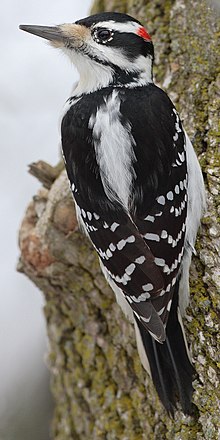
It seems kind of early, though, for woodpeckers to be drumming. Yet on January 12 a local birder reported hearing a flicker rat-a-tat-tat on her chimney flue in Seattle.
Flickers are big, polka-dotted woodpeckers found throughout North America and into parts of Central America. Properly speaking, the species is called the Northern Flicker.
Flickers found in the eastern part of the species' range flash bright yellow wing and tail linings and are known as yellow-shafted flickers; flickers of the West are rosy instead and are called red-shafted flickers. They were once thought to be separate species.
Like other woodpeckers, flickers drum to court each other and to defend their territory. They usually drum on trees, but with the diverse drum kit that humans provide, flickers have expanded their repertoire--like any enterprising musicians would. So they also drum on metal chimney flues, gutters, and other house bits and pieces. One midwestern flicker routinely used an abandoned tractor as its post. Locally, I know of a flicker who uses, to great effect, a metal streetlight as his bandstand.
We'll never know whose home had the honor of being the first to be drilled and drummed by a flicker, but the habit goes back a long way. The author Frances Staver Twining, in her 1931 book Bird-Watching in the West, describes the flicker's springtime behavior thus:
I haven't heard any drumming* or cooing so far this season, though one flicker did let out a joyous wick-wick-wick-wick, a call described by the Cornell Lab of Ornithology as "a loud, rolling rattle with a piercing tone that rises and falls in volume several times....You’ll hear it in the spring and early summer, while pairs are forming and birds are establishing their territories."
Like the varied thrush who said "Whoops! Pardon me" after letting out a trill, this particular flicker clammed up and I haven't heard him since.
Flickers are boisterous birds, however, so they'll definitely be shouting soon enough as well as drumming. The "rolling rattle" has spawned a wealth of regional common names, such as wake-up, wick-up, yucker, harry-wicket, yarrup, and yawker bird. Another call note, a piercing klee-yer, has added a few shorter names, such as clape. The drumming likewise has inspired red-hammer, yellow-hammer, and a slew of shouted epithets I will not render here.
The name "flicker" itself may be a human rendition of its rattling call, though sources also suggest that perhaps the bird's habit of flicking its tail or its bill is the source of its name.
I can't say I've noticed flickers flicking any more than other birds (and certainly not as much as a wren or sparrow). I wonder if perhaps the name was inspired by the way a flicker's dazzling red or yellow colors are revealed, like flickers of flame, when it spreads its wings and tail.
I never saw flickers when I lived back east; I've only seen these birds since moving west 25 years ago, and every single one of them was a red-shafted flicker with feathers shading from pink to crimson.
At least, until a rowdy flicker with screaming-yellow wings and tail crash-landed on the suet feeder this past weekend.
What a bird! The undersides of his wings and tail would have done a canary proud. He was a glorious lemony explosion in the middle of a dank, foggy, gray midwinter morning.

The distraction created by those beautiful feathers is what made me into the "quicker flicker picker" of the title: I did what the most newby of new birders would do, which is rush to identification before checking sources carefully. I went around crowing that we'd seen a yellow-shafted flicker.
Not so fast, cautioned wiser, calmer birders. On a birding website, they pointed out that "my" bird had a red moustache, a feature of the male red-shafted flicker; a yellow-shafted male would have a black moustache. This flicker also had facial and crest feathers that were more gray and less brown, also typical of red-shafted. However, it also had a bit of a red chevron on the back of its neck--a mark that exists in the yellow-shafted and not the red.
 So what was it? A red-shafted flicker with yellow shafts? A yellow-shafted flicker with a red moustache? None of the above. It appears to be either an intergrade flicker--a flicker who's a cross between a yellow and a red--or one that's got such an intergrade in its ancestry.
An intergrade's different from a hybrid. A hybrid is the product of two completely different species--a mule, for example, is the hybrid offspring of a horse and a donkey. An intergrade is the product of two different subspecies. Red-shafted and yellow-shafted flickers are both varieties of Northern Flicker, hence their kiddos are intergrades.
Whatever his parentage, this splendid flicker's appearance nudged me to see what John James Audubon wrote about them. He did not have anything to say about being awakened by flicker reveille at an ungodly hour, and he seemed to be genuinely fond of this species. Below is his impression of the birds (leaving out the later bit where he and an associate plunder a nest).
Do try to ponder the merriment of flickers yourself when their springtime joy bubbles over into drumming on your roof at 4:30 a.m.!
*Untrue as of 3:30 p.m. on January 13, when I heard a flicker ardently drumming on a cottonwood tree across the street.
But not if you're a bird. The male Anna's hummingbird who ferociously guards the nectar feeder in our yard is already alternating his pugnacious displays with athletic courtship dives, swooping and buzzing loudly in front of his lady love. Bufflehead ducks in ponds along the Snoqualmie Trail are courting, too, the males rapidly bobbing their heads to impress the females.
 |
| photo courtesy Wiki Commons |
It seems kind of early, though, for woodpeckers to be drumming. Yet on January 12 a local birder reported hearing a flicker rat-a-tat-tat on her chimney flue in Seattle.
Flickers are big, polka-dotted woodpeckers found throughout North America and into parts of Central America. Properly speaking, the species is called the Northern Flicker.
Flickers found in the eastern part of the species' range flash bright yellow wing and tail linings and are known as yellow-shafted flickers; flickers of the West are rosy instead and are called red-shafted flickers. They were once thought to be separate species.
Like other woodpeckers, flickers drum to court each other and to defend their territory. They usually drum on trees, but with the diverse drum kit that humans provide, flickers have expanded their repertoire--like any enterprising musicians would. So they also drum on metal chimney flues, gutters, and other house bits and pieces. One midwestern flicker routinely used an abandoned tractor as its post. Locally, I know of a flicker who uses, to great effect, a metal streetlight as his bandstand.
We'll never know whose home had the honor of being the first to be drilled and drummed by a flicker, but the habit goes back a long way. The author Frances Staver Twining, in her 1931 book Bird-Watching in the West, describes the flicker's springtime behavior thus:
The flickers are busy signalling from the ridge-pole over our sleeping heads at five o'clock in the morning. Later on in the day I am very apt to come across a pair of these energetic birds on the ground in the middle of a path. They bow to each other like partners in a quadrille, execute a few awkward steps, and converse in tones that vary from a soft coo, kuk, tut, flicker-r-r to a resounding wake-up, wake-up, wake-up! This is a flicker's courtship and his spring song.
 |
| Flicker on suet feeder, Seattle, outside our previous house |
Like the varied thrush who said "Whoops! Pardon me" after letting out a trill, this particular flicker clammed up and I haven't heard him since.
Flickers are boisterous birds, however, so they'll definitely be shouting soon enough as well as drumming. The "rolling rattle" has spawned a wealth of regional common names, such as wake-up, wick-up, yucker, harry-wicket, yarrup, and yawker bird. Another call note, a piercing klee-yer, has added a few shorter names, such as clape. The drumming likewise has inspired red-hammer, yellow-hammer, and a slew of shouted epithets I will not render here.
 |
| Male flicker keeping an eye on me at Magnuson Park. Flickers spend lots of time on the ground probing for and eating ants. |
I can't say I've noticed flickers flicking any more than other birds (and certainly not as much as a wren or sparrow). I wonder if perhaps the name was inspired by the way a flicker's dazzling red or yellow colors are revealed, like flickers of flame, when it spreads its wings and tail.
I never saw flickers when I lived back east; I've only seen these birds since moving west 25 years ago, and every single one of them was a red-shafted flicker with feathers shading from pink to crimson.
At least, until a rowdy flicker with screaming-yellow wings and tail crash-landed on the suet feeder this past weekend.
What a bird! The undersides of his wings and tail would have done a canary proud. He was a glorious lemony explosion in the middle of a dank, foggy, gray midwinter morning.
The distraction created by those beautiful feathers is what made me into the "quicker flicker picker" of the title: I did what the most newby of new birders would do, which is rush to identification before checking sources carefully. I went around crowing that we'd seen a yellow-shafted flicker.
Not so fast, cautioned wiser, calmer birders. On a birding website, they pointed out that "my" bird had a red moustache, a feature of the male red-shafted flicker; a yellow-shafted male would have a black moustache. This flicker also had facial and crest feathers that were more gray and less brown, also typical of red-shafted. However, it also had a bit of a red chevron on the back of its neck--a mark that exists in the yellow-shafted and not the red.
An intergrade's different from a hybrid. A hybrid is the product of two completely different species--a mule, for example, is the hybrid offspring of a horse and a donkey. An intergrade is the product of two different subspecies. Red-shafted and yellow-shafted flickers are both varieties of Northern Flicker, hence their kiddos are intergrades.
Whatever his parentage, this splendid flicker's appearance nudged me to see what John James Audubon wrote about them. He did not have anything to say about being awakened by flicker reveille at an ungodly hour, and he seemed to be genuinely fond of this species. Below is his impression of the birds (leaving out the later bit where he and an associate plunder a nest).
Do try to ponder the merriment of flickers yourself when their springtime joy bubbles over into drumming on your roof at 4:30 a.m.!
"It is generally agreeable to be in the company of individuals who are naturally animated and pleasant. For this reason, nothing can be more gratifying than the society of Woodpeckers in the forests. To prove this to you, kind reader, I shall give you a full account of the habits of the Golden-winged Woodpecker....No sooner has spring called them to the pleasant duty of making love, as it is called, than their voice, which, by the way, is not at all disagreeable to the ear of man, is heard from the tops of high decayed trees, proclaiming with delight the opening of the welcome season.
Their note at this period is merriment itself, as it imitates a prolonged and jovial laugh, heard at a considerable distance. Several males pursue a female, reach her, and, to prove the force and truth of their love, bow their heads, spread their tail, and move sidewise, backwards and forwards, performing such antics, as might induce any one witnessing them, if not of a most morose temper, to join his laugh to theirs.
Even in confinement, the Golden-winged Woodpecker never suffers its naturally lively spirit to droop. It feeds well, and by way of amusement, will continue to destroy as much furniture in a day as can well be mended by a different kind of workman in two. Therefore, kind reader, do not any longer believe that Woodpeckers are such stupid, forlorn, dejected and unprovided for beings as they have hitherto been represented. In fact, I know not one of the species found in our extensive woods, that does not exhibit quite as much mirth and gaiety as the present bird."
*Untrue as of 3:30 p.m. on January 13, when I heard a flicker ardently drumming on a cottonwood tree across the street.