Pages

Thursday, February 28, 2013

Yes, That IS a String of Cheetos Hanging From the Eaves. It's SCIENCE.

Let it not be said that the residents of our household do not have Inquiring Minds. Science: It's what's for breakfast. And for sleepover snackses.

For the past three weeks we've had a rain-chain of Cheetos hanging from the front eave of the house. It was draped there by a gaggle of girls whom the Resident Teen had invited over for a sleepover (though to be precise it was more of a movie-over, or a feast-over, or something, with  lots of texting mixed in). 

It came to my attention when I wandered into the living room, which was momentarily the only quiet place in the house, and saw this weird apparition bobbing outside the window, backlit by the streetlights. 

Amazing, how quickly the brain works: "What is THAT? Oh, of course. It's Cheetos tied to a string. Suspended from the eave."

A request was made not to disturb the Cheeto-chain because the science squad wanted to see how long it would take for birds to eat the snacks. Sure, fine, whatever. 

(Never mind that I can cause my offspring terrible embarrassment merely by being seen at school, or by breathing too loudly, or by blinking too rapidly. Apparently decorating one's house with snack foods is perfectly acceptable.)

I assumed the crows would make off with the cheese puffs in no time. I've seen them wolfing down Cheetos in parks and playgrounds, after all, and here they were getting them served up virtually on a silver platter. Barring that, the little orange squiggles would surely grow moldy and disintegrate. (Talk about shabby-chic decor for your home!)

Well, that was the hypothesis. Much to our surprise, the crows did not gobble up the experiment. Nor did the snacks grow moldy. They lost volume as they dried out (the Resident Teen noted that they'd gotten pretty tough), and didn't regain any size even when they grew spongy with rain. 

Get thee behind me, Doodles!
Otherwise, I think they may have persisted in the environment for a very, very long time (except that the teenage scientist finally and unceremoniously yanked the Cheeto-chain off the house and threw it away). The secret to eternal life probably lies in the preservatives used to ensure a long shelf life for cheese puffs. 

OK, I know full well that snack foods like this are the opposite of kale chips. I have come a long way from craving the Cheez Doodles I loved so much as a kid. 

And I know that one should be suspicious of foods that come in bags that warn you to keep them out of the light. (I can't recall what brand of cheesy snacks required darkness--or should I say "cheezy snax," as weird spelling seems to be required when describing cheese-flavored cornmeal puffs).

But don't let a bag of them anywhere near me because I can still hear their siren song....

Curious to find out more about the latest in cheese-puff science, I went a-Googlin', and was newly amazed by the creative capacity of my fellow human beings (and in some cases astonished by just how much time can be wasted, and--to go for a trifecta of adjectives beginning with A--appalled by  just how bad bad taste can be, and we're not talking about the taste of the cheese puffs).

This is a cheetah, not a Cheeto. Couresty Wikipedia.
There is a blog that covers an entire summer's worth of Cheeto science experimentation. You can find out just what's in a Cheeto here. There are people who make artworks out of Cheetos: one woman made an entire Cheeto room complete with furniture and people, and another artist uses that neon orange dust that collects at the bottom of a Cheetos bag to make portraits, such as a cheesy one of Elvis on black velvet. There are teachers who have little children eat Cheetos in order to teach them about pollination. (I kid you not. I suppose the next unit in their science classes is Nutrition.)

There are also lots of chickens, corn snakes, orange-tabby cats, hamsters, and other animals named Cheeto. (I have even personally met one of these animals, and  he is said to be a good rat-catcher.) 

Other fun cheese-puff facts for those seeking to snack on junk-food trivia: 

Cheese puffs were apparently discovered by accident in the 1930s as a worker making flaked corn for cattle feed noticed that damp cornmeal heated by a flaking machine's motor caused the cornmeal to be extruded in long threads. Add flavoring to extruded, damp, warm cattle feed, and voila! A snack sensation is born!

Cheetos were the first American snack food to be produced and distributed in China (in 1994). According to Wikipedia, taste tests were performed first, with "ranch dressing, North Sea crab, smoked octopus and caramel being passed up for two flavors: Savory American Cream and Zesty Japanese Steak."

Django watched the Cheeto-chain for HOURS.
Wise snack-food company makes cheese puffs that look like crocodiles.

There are apparently people who will pay $35.18 to purchase Cheetos on ebay that purport to resemble Michael Jackson  moonwalking.

Wotsits are the UK's version of cheese puffs, and you can get them in prawn-cocktail flavor. They also once made a product called "Mealtime Potato Shapes," which shows that they really desperately needed a marketing department.

Right, that's quite enough of that. Onward. What science projects do you have hanging around your house, literally or figuratively (not counting the ones we all have lurking in the back of the refrigerator in mysterious food-storage containers)?




Friday, February 22, 2013

Gray Days and Braying Jays

There are many East Coast birds that I miss a great deal even after a quarter-century of living in the Pacific Northwest.

Among them are cardinals,  with their blood-red feathers; mockingbirds, who somersault from TV aerials while belting out a medley of Top-40 birdsongs; brown thrashers, strutting like rusty peacocks across the lawn;  common grackles with their uncommonly iridescent feathers glistening purple and green; blue jays crisply decked out in cobalt and white with black trim.

Not that we're lacking for nice birds in this part of the world; varied thrushes, Pacific wrens, and chestnut-backed chickadees aren't too shabby, after all. But none of these show up regularly in my garden, whereas those East Coast birds practically lined the window ledges of my split-level childhood home.
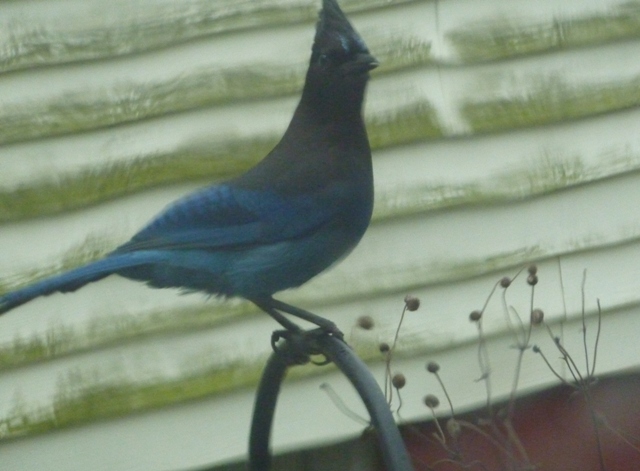
The Steller's Jay who suddenly discovered our feeders.

So I was pretty pleased when Steller's Jays turned up in my area a few years ago, though I am fairly certain that this isn't the prevailing opinion in the neighborhood. Steller's Jays are nearly crow-sized birds that wear blue body feathers with a cape and crest of black. They're very attractive--but also very noisy and assertive.

The fact that they rob other birds' nests and eat the eggs and young uncomfortably suggests that their garb is an executioner's hood, though of course they're just trying to survive like any other animal. Still, it's not a habit that warms people's hearts.

They are birds of coniferous forests (of which there's no shortage in Washington), so the local ones tend to hang out in the neighborhood's tallest evergreens. They scream, squawk, and rattle as they trade catcalls wtih the crows.
Steller's Jay in our backyard birch tree.
Field guides devote a lot of space to the jays' raucous vocabulary: the Audubon field guide says they scream shack-shack-shack and chook-chook-chook; Kaufman's guide describes it as kessh, kesssh, and shek-shek-shek; Sibley hears shek shek shek shek but also shaaaaar (give or take an a). A 1968 Seattle Audubon bird guide agrees about shack shack shack but also catches a flitch-flitch-flitch in the cacaphony.

William Leon Dawson, writing in 1923, says the bird's cries are "harsh and expletive," noting that "Shaack, shaack, shaack is a common (and most exasperating) form," though he also acknowledges the jay sometimes emits a "mellow klook, klook, klook."

But it's Wikipedia (not a reliable resource but often fun to consult) that seems to get the greatest kick out of the jay's language. "One common call is a harsh SHACK-Sheck-sheck-sheck-sheck-sheck series; another skreeka! skreeka! call sounds almost exactly like an old-fashioned pump handle; yet another is a soft, breathy hoodle hoodle whistle. Its alarm call is a harsh, nasal wah....Some calls are sex-specific: females produce a rattling sound, while males make a high-pitched gleep gleep."

Every source cites the jay's ability to imitate a red-tailed hawk. A few claim the jay impersonates the hawk in order to frighten smaller birds away from food sources, but having seen how quickly a big jay blustering up to the bird feeder can disperse a flock of sparrows, I doubt it really needs to play vocal tricks to get what it wants. Like crows, ravens, and other corvids, jays are simply excellent mimics; Steller's jays have been heard borrowing the sounds of squirrels, dogs, chickens, and other animals. (I once heard a crow in a Grand Canyon campground do an excellent imitation of human snoring.)

Though the jay's shrieking and rasping probably sounds like nails on a blackboard to most people, it's a useful barrage for birds and other animals in the wild. The Steller's Jay is a very alert sentinel. Dawson notes that "to do him justice, it is usually the Steller Jay who is first to make discovery and outcry if there is any mischief afoot in the woods."

The jay's policing of the forest was also noted by Thomas Nuttall, a contemporary and fellow naturalist of John James Audubon. Audubon painted the jay, but in describing the bird quoted extensively from Nuttall, who reported that jays are "watchful as dogs" and that "a stranger no sooner shews himself in their vicinity than they neglect all other employment to come round, follow, peep at and scold him, sometimes with such pertinacity and irritability as to provoke the sportsman intent on other game to level his gun against them in mere retaliation."

He adds, "At other times, stimulated by mere curiosity, they will be observed to follow you in perfect silence, until something arouses their ready ire, when the djay, djay, pay, pay, is poured upon you without intermission, till you are beyond their view. So intent are they on vociferating, that it is not uncommon to hear them busily scolding even while engaged with a large acorn in the mouth."

Audubon also repeats information from naturalist John Kirk Townsend, who told him that the Chinook Indians called the bird "Ass-ass" (as I am sure some householders trying to sleep in on a Saturday might likewise be inclined to grumble with full Anglo-Saxon meaning intact). He went on to claim that the Chinook "regard it with a superstitious feeling, believing that should a person hear it enunciating certain notes, which resemble the syllables jaa-jaa, he will shortly die, whereas its other notes, kuc, kuc, kuc, kuc, rapidly repeated, portend good."

Uh-oh! Mr. Jay has spotted me through the window.

I must admit that I wasn't exactly thrilled to have this jay arrive at the feeder--he's a bit of a hog, and certainly cleared out the restaurant of all other customers, including the hummingbird. And I remember how one of his kind woke us up at the break of dawn on a camping trip when it invaded the nest of a cheerful family of sparrows living in a shrub beside our tent. Still, it's pretty cool to have such a big, rowdy, flamboyant bird brashly swaggering around in one's soggy, gray-green winter garden. If you can't have cardinals, that is.

Tuesday, February 19, 2013

Heartfelt Art Felt Oregon Onion

Today's post is written by a guest blogger, Bria Onion, who came home with me from a trip to Oregon this weekend.

Hello. My name is Bria Onion. I sprout from Eugene, Oregon. 

At least, that was my previous stop en route from the Felty World of Eliel's Felties. With the help of Eliel, some sharp needles, and loads of woolly roving (thanks, sheep!), I came into being.

I left behind my felty friends (assorted flying pigs, asparagus spears, rabbits, plesiosaurs, penguins, and more) to come north to Seattle.

I traveled inside a shoe, which seemed made to order for my shape and size.

The shoe was inside a bag, which was inside a train.

So I guess I actually traveled inside a lot of things. We onions do like layers.

Being an onion, I did shed a few tears.


But I quickly recovered.

Then I said hello to the family dog.  This was a very brief hello.

I didn't want the dog to get any funny ideas, because, after all, I am a bit fuzzy like a tennis ball.

At first, I was a little lost, because I'm used to being surrounded by other Felties.

But this feeling didn't last for long. 
In the kitchen, I was immediately welcomed by a small pumpkin and a Valentine cookie, so I soon felt at home.

Now I'm happily ensconced on a shelf quite out of reach of the cats, where I have very pleasant chats with a little Yellowstone-souvenir bear in a crate from the 1930s and a stuffed polka-dotted flying squirrel. As you can imagine, they have a lot of stories to share. 

My backstory includes a stint as a placeholder in books, so I'm looking forward to delving into some new titles here.

My reading list includes "The Black Scallion," "The Time of Our Chives," Steinbeck's "The Pearl Onion," and the classic E. B. White story "Shallot's Web."

Oh, and "The Onion," of course.

I'm looking forward to meeting the felted pincushion who my new friends say lives elsewhere in the house. Cheers!


Wednesday, February 13, 2013

Happy Valentine's Day...That's All


Valentine's Day Roses from a past year
Luna Lovedog, birthday Feb. 14, Superhero

Heart of a Dianthus flower, spring 2012
Roses, neighborhood steps, 2011
Django the Art Cat, with 'heartwork' in bowl, date unknown
   
Yours truly, Valentine's Day dress, 1967

Monday, February 4, 2013

In Memoriam


In Memory of Maia H.
February 3, 1989-January 27, 2013
beloved daughter of a dear friend
untimely ripped from this world

"Nothing fine will ever perish 
as long as there are hearts to remember."
--Kate Seredy, The Chestry Oak


Tuesday, January 29, 2013

Jane Austen, Orangutans, Sheep Tongues, and Trifle

From JASNA
It is a truth universally acknowledged, that anybody in possession of a blog must be in want of an opening sentence--and that if the blog post is going to be about Jane Austen and Pride and Prejudice, the opening sentence is going to be some version of the first line of that book, pummeled into shape to suit the text that follows.

Yesterday, Monday, January 28, 2013, marked the 200th anniversary of the publication of Pride and Prejudice. This event's being celebrated worldwide by Austen fans with readings, marathon movie viewings, parties, and more. Counting ourselves among her fans, we didn't want to be left out of the fun.

(Jane's modern-day fans are also said to include a 40-year-old orangutan named Albert who lives in a Polish zoo and his partner Raya, putting a whole new spin on the notion of "Me Tarzan, you Jane." If they don't get a nightly reading of 50 pages of her work, they throw fruit snacks around and refuse to sleep. And you parents of toddlers thought you had it rough.)

We (or should I say "I," as I'm the bossy social-relations rep, chief Austen fan, and cook in the household) decided to celebrate by having a Regency-era dinner with old friends, one of whom was once in a Jane Austen book club with me and who also worked with me as a docent at Woodland Park Zoo (a nice commingling of Austen and Orangs).

The Jane Austen Cookbook by Maggie Black and Deirdre Le Faye provided plenty of recipes for perusal. Some were unwieldy or called for ingredients that would be kind of expensive or difficult to obtain, such as Pigeon Pie and Harrico of Mutton. Others sounded stodgy or dull or just a lot of work for little reward. A few sounded worth making just because they had amusing names (Forcemeat Balls, anyone? No? Then how about some Solid Syllabubs?)

I finally decided on Chickens with Tongues.

Yes, chickens have tongues. But no, this recipe didn't call for chicken tongues. The tongues in question were sheep tongues. Which apparently weigh a quarter-pound each and take more than 2 hours to simmer to cooked perfection.

Not that I was going to try this at home. I still remember when I was about six or so, and my German grandmother was living with us, and I used to sneak friends into our kitchen so I could show them the packaged, sliced "bologna with tongue" that she kept in the meat tray of the fridge. I'd hold it up because there, embedded in the slices, were slivers of tongue, like specimens in a glass slide. Ewwww! I should've done this at Halloween and charged admission.

Even the author suggested that "boiling sausages will provide a suitable flavour contrast to the chicken in an acceptable shape."

That wasn't the only substitution I made: The boiled "poussins" (month-old chickens weighing a pound or less) were replaced by roasted chicken breasts (being from modern behemoth chickens, each of these probably outweighed a poussin). The boiled cauliflower, at the author's suggestion, was replaced with rice. I swapped the boiled spinach for broccoli, and left out the rashers.

But we did pile it all one on plate, with the rice in the middle and the chicken, sausages, and broccoli fanned out around it, because the author noted that "This dish illustrates beautifully the Regency delight in symmetry and display, shown in precise shapes and colours--even on the dinner-table. An interesting dish for a small, formal supper."

The result was like a birthday cake you make following the instructions in a book only to have your cake come out looking like a candidate for the website "Cake Wrecks." Oh well. Like the cake, it was still tasty. We served it with more broccoli, as well as bashed neeps (mashed rutabaga) and a green salad. Dessert was a trifle from a recipe in Irish Traditional Cooking by Darina Allen.

We did not read aloud from Pride and Prejudice, but fortunately this did not cause people to throw fruit snacks or trifle or any other foods.

I wondered what Jane herself would have made of the hubbub surrounding her book's anniversary. I bet she would've liked it--she seemed to have a great sense of humor, a taste for the absurd, and a great talent for making wry comments. 

"Such wonderful condescension!"
The book wasn't overlooked in its time, either, and it enjoyed some favorable reviews (presumably written by primates with less fur than Albert). One reviewer called the book a "very agreeable novel" that "rises very superior to any novel we have lately met with in the delineation of domestic scenes."

The writer of the review, which appeared in a journal called Critical Review in October 1813, refers to Jane as the "fair author." (Of the odious boot-licking Mr. Collins, he says, with great restraint, that he is "indeed a notable object.")

Jane herself wryly commented on her book in a letter to her sister Cassandra, mocking the popular notion at that time that novels written by women were sentimental drivel and novels written by men were deep and intellectual:

"Upon the whole...I am well satisfied enough. The work is rather too light, and bright, and sparkling; it wants shade; it wants to be stretched out here and there with a long chapter of sense, if it could be had; if not, of solemn specious nonsense, about something unconnected with the story: an essay on writing, a critique on Walter Scott, or the history of Buonaparté, or anything that would form a contrast and bring the reader with increased delight to the playfulness and general epigrammatism of the general style."

I bet very few of those guys got to have an Archie McPhee action figure made of them, complete with writing desk and quill pen!

Thursday, January 24, 2013

Happy Burns Day, and a Book Rescue


Tomorrow, January 25, is Robbie Burns Day--the birthday of Scottish poet Robert Burns (who, according to Wikipedia, is also known as Rabbie Burns, Scotland's favorite son, the Ploughman Poet, Robden of Solway Firth, the Bard of Ayrshire, and, in Scotland, as The Bard).

I will leave it to you, dear reader, to delve into original source material (or Wikipedia, as you wish) to find out  more about the man who penned "Auld Lang Syne," "To a Red, Red Rose," and more. Despite having been an English major, I have had very little contact with Robert Burns and his work.

Which means I also did not know much about Robbie Burns Day and the wonderful institution of having a Burns supper, replete with ritual, special dishes, speechifying, and levity to spare. Rats.

A herd of haggises (Wikipedia)
Not that I ever, ever want to try haggis, that saggy sack of sheep's insides mixed with oatmeal, spices, and onions, though I'm insanely jealous that the Scots have a food that is brought to the table accompanied by the skirl of bagpipes and that is then celebrated in verse ("Address to a Haggis," by guess who). I can safely say I've never called anything put before me the "great chieftain o' the puddin-race."

But I can say that I Have Done My Bit for Scottish poetry. (Film of calendar pages flipping back through time, here.)

A few years ago, I was in downtown Seattle with a friend of mine who enjoys treasure-hunting at the Goodwill Outlet.  Yes, Goodwill, that outlet of outlets, actually has an outlet of its own. It is the last step for objects before they are recycled, thrown away, or, in the case of clothing, shredded to make rags or baled up for shipment to Africa and other overseas markets.

At the outlet, most of what you buy is priced by the pound. You shove it into a sack and they weigh it at checkout. Other items, such as books and appliances, have a different (though still very low) pricing setup.

A glance at the contents of the battleship-sized wheeled blue bins reveals why most of this stuff never sold in the Goodwill store itself (it's ugly!), but it's amazing and somewhat disheartening to see just how much good stuff is mixed in with the jetsam.

My friend L. has found vintage, high-quality clothing and even antiques, such as a century-old handmade quilt and a darning egg. My daughter found a brand-new Breyer stuffed horse, clean with the tags still on. I found a brand-new L.L. Bean down coat for a friend's young son. I met one woman who scours the bins for brand-new or barely used baby clothing, which she takes home, washes, and then donates to organizations that will make sure they actually end up on babies and not in the shredder or baler.

The outlet has its own rules and culture. One of the cardinal rules is that, when a new bin is rolled out, nobody touches a thing in it until a Goodwill employee gives the signal. The "regulars" at the outlet immediately surround a bin when it's put into place, positioning themselves around it like diners at a feast--though in this case it's more like contestants at a hotdog-eating contest. It's rather fearsome.

Most casual visitors, like me, stand back and cede this turf to the regulars, who seem to be made up of people who are truly down on their luck as well as people who dive for treasure to sell on eBay or in vintage shops.

On one of my rare visits, I was present when a new bin of books rolled out. The book bins are usually pits of remainders, tattered romance and mystery  novels, old magazines, ancient Reader's Digest condensed books, outdated textbooks, and the like, but sometimes there can be decent copies of novels, children's books, and the odd, interesting vintage volume.

So when I saw hordes of people descend on the new bin and take their stations, I naively thought they were avid readers or book collectors eager to see what possible literary gems might lie in this ultimate slush pile.

Not a book collector. (Wikipedia)
Which shows you what an idiot I am.

When the signal to dive in was given, the chaos that ensued was like a nature documentary about vultures ripping into a dead elephant. People grabbed books willy-nilly and flung them by the armload into shopping carts and rolling canvas bins. Woe betide the person standing in the wrong place if volume M of an encyclopedia came flying through the air.

As the bin emptied, the book-flingers trundled their carts off to the outlets' sides, where they quickly sorted through their haul. Some had hand-held devices for scanning bar codes on the books. I don't have a clue as to what, exactly, people sought in their purchases, but after a quick sorting they began bringing the rejects back to the bin and unceremoniously chucking them back in.

At this point, the book barge was now attended by only a few pickers, and I tentatively joined them. That's when--whump!--a big brown book was tossed back onto the heap. A big brown book with gold embossed on the cover, deckled edges, and no bar code.

It turned out to be an edition of Robert Burns's poetry published in the late 1800s. It showed its years; the binding was ragged, a mouse had nibbled the corners, ink stains marred its edges.

But it was beautiful, just a beautiful object. Holding it, you got a sense of how, before mass production make cheap clothing and books possible, a book might be something you'd cherish and pass along through generations, even if you didn't particularly love the poems inside it.

I couldn't believe such a book didn't make the pickers' cut, though later I understood why; eBay alone had several of these old books, and they weren't budging at only eight bucks. But still, this book needed rescuing, so for 50 cents I took it home.

Over the next few weeks, I picked it up from time to time to admire the details and care that had gone into producing it.

It was filled with elegantly wrought engravings of lonely lasses, mournful dogs, heaths and moors. When I ran my hand over the fine-quality paper of pages, I could feel the impression of the type on the other side of each page.

Even the penmanship of the book's owner was a little work of art.

This book would prove to be one with a most happy ending.

One day, during my  monthly craft-group gathering, conversation turned to the Robbie Burns night celebration enjoyed by one of my friends, who is married to a Scotsman. She told us about the speeches, the haggis, and the existence of a rather tasty vegetarian version of haggis (who knew?).

It was quite clear where this edition of Burns's work belonged--and so it was passed along (without any flinging, Highland or otherwise) and now resides in a place of honor on a desk, where it's regularly perused by my friend's children.

So, Happy Birthday, Robert Burns.  “Should auld acquaintance be forgot and never brought to mind?" Not this edition of your work, at least.