Pages

Wednesday, February 4, 2015

The Weird Vintage Pop-up Books in the Basement

The creepy pop-up clown.
When I was a kid, I was always amazed to read stories in which the child protagonists felt fortunate to own a book.

I loved to read, so it wasn't that I thought a book was a strange item to cherish. It was just that books seemed like something everybody had, like air, or spoons.

Books were indeed plentiful and relatively inexpensive by the time the 1960s had rolled around (for a typical middle-class family, that is, such as mine).

My childhood home was awash in Little Golden Books, Big Little Books, and "I Can Read It All By Myself" Beginner Books. School order forms for paperback books routinely trailed me home, and books regularly appeared wrapped up for birthdays and Christmas.

There were also the somewhat mysterious books that had come down through the ages to reside alongside our colorful books on the shelves. At least, they seemed to me as if they came from antiquity--they dated back to my mother's childhood, a time that seemed as distant to me as Jane Austen's heyday. (I believed her when she said, after being badgered for hours by five-year-old me to reveal her age, that she was 100 years old.)

Among those books were four battered cardboard books filled with clever pop-ups and some vaguely unsettling illustrations.

I didn't like the stories very much, but I did enjoy opening the books to the pages that contained the pop-ups.

My mom always spoke reverently of the books, noting that they were very old and very valuable.

She wasn't far off the mark--they would have been valuable, if they weren't in terrible condition. Though they'd come by that condition honestly; they'd been read to pieces by my mom and her brother when they were kids.

My uncle had also colored in most of the pictures with paints. He filled them in very neatly and carefully, but I don't think they've done much to increase the books' value.

Their value wasn't further enhanced when one of my siblings, discomfited by some of the distorted, exaggerated features of various characters, went through the books and cut off the heads of many of the pop-up people and animals.

In researching the books, I learned they were part of a British book series called Bookano Books (which made sense family-history-wise, because they'd been sent from Ireland by my great-grandmother to my uncle in the 1930s).

Their creator, a publishing-industry executive named S. Louis Giraud, teamed up with a paper engineer named Theodore Brown to create pop-up books that featured "mechanical" moving parts. The name "Bookano" was a blend of the words "book" and "Meccano," the name of a popular European building-toy kit. The team produced 16 or 17 books between 1929 and 1949 (sources vary on the number).

Giraud geared the books to sell to a wide audience by using very thick, cheap paper, inexpensive printing techniques, and low-cost bindings (which is obvious to collectors of the falling-apart books) so that the books could be priced low. Oddly, it's the colorful pop-ups in each book that have best stood the test of time.


Bookano Books was also a cottage industry. Cutting out and constructing the pop-ups was a job hired out to women working from home. The materials would be delivered to them and picked up when finished. The pop-ups' claim to fame was that they could be viewed from all angles.

That was a big part of their appeal, and I can personally attest to that appeal because I spent a lot of time getting down on eye level with the books to peer into some of the scenes. I remember being particularly fascinated by this one, with characters gathered around a table, because you could see them from the front and the back, unlike a flat illustration in a book.


I don't know why I thought this was magical--I certainly didn't regard my three-dimensional toys in this way. I suppose there was just something about the 2-D managing to be 3-D that was inherently amazing, like View-Master slides. Or like getting one of those postcards with a plastic corrugated front that turned the picture into a 3-D image. (I spent a few hours of my youth trying to peel the plastic off one of those cards so as to enter the world of Mowgli and Baloo the Bear on a Disney postcard. I never succeeded.)


The regular illustrations in the books were, as mentioned previously, just kind of weird. I mean, jeepers. Check out this one. The first of many scary ringmasters in children's books. And clowns.


The comical stories were illustrated in a style similar to that used in the early Disney cartoons, with exaggerated features and rubbery limbs, lots of big teeth and giant nostrils. The serious fairy tales' illustrations were peopled by stiffer, more remote characters. The writing varied from formal and wordy to overwhelmed-by-cupcakes cheerful.

There were stories the likes of which you'd probably not find in the children's section today:


And I don't think I've ever run across the words "eunuch" and "female slaves" in any other children's books outside of these ones.

But the books' endpapers often delighted with more enchanting images:


The pop-ups really could be astonishing, such as this one of a Red Admiral butterfly and an orchid:


Though I don't think I'll ever forgive Bookano for giving me nightmares about clowns.


Monday, January 19, 2015

A Crescendo of Crows

As evening falls, the crows arrive.

First just two or three. Then clusters of half a dozen or more. Calling, cawing, the crows wing their way over our house, a black arrow of birds pointing to the west.


The crows look purposeful, and they are. They are heading home from a day spent gleaning in fields, parks, and city streets to roost for the night at the UW Bothell campus, along with  more than 10,000 others of their kind.


My husband and I headed there, too, one recent evening to watch for their arrival. The sky was that wash of pink and blue peculiar to midwinter dusk, with purple shades of night seeping in around the edges.


And then the pink and blue became speckled with bits of black. From all directions, the crows came, from Seattle and Sultan, from Snohomish and Skykomish. Their cawing grew from a few raucous cries to a seething, swirling wall of sound.


Crows perched on the roof and in the trees. Late arrivals gathered on the grass before looking for spaces in the crowd. Clusters of crows would startle and fling themselves into the air, making the constant crow-clatter rise and fall, swoop and turn.

The crows aren't here to feed. Nor are they hatching plans to conquer the human race. They're simply seeking safety in numbers.

By nightfall, they'll all be tucked into the willow trees and other vegetation growing thickly in the wetlands on campus. It's a slumber party inspired by a mutual desire to not get picked off by a hungry great horned owl.

These highly social and smart birds have a lot to say before settling down for the night. Who knows what they're sharing as they caw, cackle, and squawk?

By the time we left, the crows had vacated the rooftops. A few stragglers flew in, making straight for the trees; it was easy to imagine they were stealing glances over their shoulders, convinced that an owl was just a few flaps behind them.

At sunrise, the crows will awaken, stretch, and fly off for another day of scavenging, socializing, preening, and playing. Many will head for familiar places while some may be inspired to tag after other birds and find new feeding grounds.


By late spring, the crows will disperse throughout the region, busy with mating, nesting, and raising young. They'll stay in their home territories throughout the summer. In fall, all the crows--youngsters on up to crows that have been around for 30 or 40 years--will resume trekking to the campus to roost in the trees.


Tuesday, January 13, 2015

The Quicker Flicker Picker

The holiday lights have been put away. The Christmas cookies are long gone. We enter the dank slog through January and February's winter weather, a season that's always felt very long and dreary to me, made more so by sad memories of bad things that have happened to loved ones during this time. Spring, growth, and renewal seem very remote.

But not if you're a bird. The male Anna's hummingbird who ferociously guards the nectar feeder in our yard is already alternating his pugnacious displays with athletic courtship dives, swooping and buzzing loudly in front of his lady love. Bufflehead ducks in ponds along the Snoqualmie Trail are courting, too, the males rapidly bobbing their heads to impress the females.

photo courtesy Wiki Commons
And I heard a varied thrush trill the other day--just one short trill that broke off abruptly, as if the bird had surprised itself and was now standing quietly, bashfully putting a wing over its beak and looking around in mock alarm, wondering who spoke out of turn.

It seems kind of early, though, for woodpeckers to be drumming. Yet on January 12 a local birder reported hearing a flicker rat-a-tat-tat on her chimney flue in Seattle.

Flickers are big, polka-dotted woodpeckers found throughout North America and into parts of Central America. Properly speaking, the species is called the Northern Flicker.

Flickers found in the eastern part of the species' range flash bright yellow wing and tail linings and are known as yellow-shafted flickers; flickers of the West are rosy instead and are called red-shafted flickers. They were once thought to be separate species.

Like other woodpeckers, flickers drum to court each other and to defend their territory. They usually drum on trees, but with the diverse drum kit that humans provide, flickers have expanded their repertoire--like any enterprising musicians would. So they also drum on metal chimney flues, gutters, and other house bits and pieces. One midwestern flicker routinely used an abandoned tractor as its post. Locally, I know of a flicker who uses, to great effect, a metal streetlight as his bandstand.

We'll never know whose home had the honor of being the first to be drilled and drummed by a flicker, but the habit goes back a long way. The author Frances Staver Twining, in her 1931 book Bird-Watching in the West, describes the flicker's springtime behavior thus:

The flickers are busy signalling from the ridge-pole over our sleeping heads at five o'clock in the morning. Later on in the day I am very apt to come across a pair of these energetic birds on the ground in the middle of a path. They bow to each other like partners in a quadrille, execute a few awkward steps, and converse in tones that vary from a soft coo, kuk, tut, flicker-r-r to a resounding wake-up, wake-up, wake-up! This is a flicker's courtship and his spring song.

Flicker on suet feeder, Seattle, outside our previous house
I haven't heard any drumming* or cooing so far this season, though one flicker did let out a joyous wick-wick-wick-wick, a call described by the Cornell Lab of Ornithology as "a loud, rolling rattle with a piercing tone that rises and falls in volume several times....You’ll hear it in the spring and early summer, while pairs are forming and birds are establishing their territories."

Like the varied thrush who said "Whoops! Pardon me" after letting out a trill, this particular flicker clammed up and I haven't heard him since.

Flickers are boisterous birds, however, so they'll definitely be shouting soon enough as well as drumming. The "rolling rattle" has spawned a wealth of regional common names, such as wake-up, wick-up, yucker, harry-wicket, yarrup, and yawker bird. Another call note, a piercing klee-yer, has added a few shorter names, such as clape. The drumming likewise has inspired red-hammer, yellow-hammer, and a slew of shouted epithets I will not render here.

Male flicker keeping an eye on me at Magnuson Park. Flickers spend
lots of time on the ground probing for and eating ants.
The name "flicker" itself may be a human rendition of its rattling call, though sources also suggest that perhaps the bird's habit of flicking its tail or its bill is the source of its name.

I can't say I've noticed flickers flicking any more than other birds (and certainly not as much as a wren or sparrow). I wonder if perhaps the name was inspired by the way a flicker's dazzling red or yellow colors are revealed, like flickers of flame, when it spreads its wings and tail.

I never saw flickers when I lived back east; I've only seen these birds since moving west 25 years ago, and every single one of them was a red-shafted flicker with feathers shading from pink to crimson.

At least, until a rowdy flicker with screaming-yellow wings and tail crash-landed on the suet feeder this past weekend.

What a bird! The undersides of his wings and tail would have done a canary proud. He was a glorious lemony explosion in the middle of a dank, foggy, gray midwinter morning.


The distraction created by those beautiful feathers is what made me into the "quicker flicker picker" of the title: I did what the most newby of new birders would do, which is rush to identification before checking sources carefully. I went around crowing that we'd seen a yellow-shafted flicker.

Not so fast, cautioned wiser, calmer birders. On a birding website, they pointed out that "my" bird had a red moustache, a feature of the male red-shafted flicker; a yellow-shafted male would have a black moustache. This flicker also had facial and crest feathers that were more gray and less brown, also typical of red-shafted. However, it also had a bit of a red chevron on the back of its neck--a mark that exists in the yellow-shafted and not the red.

So what was it? A red-shafted flicker with yellow shafts? A yellow-shafted flicker with a red moustache? None of the above. It appears to be either an intergrade flicker--a flicker who's a cross between a yellow and a red--or one that's got such an intergrade in its ancestry.

An intergrade's different from a hybrid. A hybrid is the product of two completely different species--a mule, for example, is the hybrid offspring of a horse and a donkey. An intergrade is the product of two different subspecies. Red-shafted and yellow-shafted flickers are both varieties of Northern Flicker, hence their kiddos are intergrades.

Whatever his parentage, this splendid flicker's appearance nudged me to see what John James Audubon wrote about them. He did not have anything to say about being awakened by flicker reveille at an ungodly hour, and he seemed to be  genuinely fond of this species. Below is his impression of the birds (leaving out the later bit where he and an associate plunder a nest).

Do try to ponder the merriment of flickers yourself when their springtime joy bubbles over into drumming on your roof at 4:30 a.m.!

"It is generally agreeable to be in the company of individuals who are naturally animated and pleasant. For this reason, nothing can be more gratifying than the society of Woodpeckers in the forests. To prove this to you, kind reader, I shall give you a full account of the habits of the Golden-winged Woodpecker....No sooner has spring called them to the pleasant duty of making love, as it is called, than their voice, which, by the way, is not at all disagreeable to the ear of man, is heard from the tops of high decayed trees, proclaiming with delight the opening of the welcome season. 
Their note at this period is merriment itself, as it imitates a prolonged and jovial laugh, heard at a considerable distance. Several males pursue a female, reach her, and, to prove the force and truth of their love, bow their heads, spread their tail, and move sidewise, backwards and forwards, performing such antics, as might induce any one witnessing them, if not of a most morose temper, to join his laugh to theirs. 
Even in confinement, the Golden-winged Woodpecker never suffers its naturally lively spirit to droop. It feeds well, and by way of amusement, will continue to destroy as much furniture in a day as can well be mended by a different kind of workman in two. Therefore, kind reader, do not any longer believe that Woodpeckers are such stupid, forlorn, dejected and unprovided for beings as they have hitherto been represented. In fact, I know not one of the species found in our extensive woods, that does not exhibit quite as much mirth and gaiety as the present bird."

*Untrue as of 3:30 p.m. on January 13, when I heard a flicker ardently drumming on a cottonwood tree across the street.


Friday, January 2, 2015

First Bird of the Year 2015

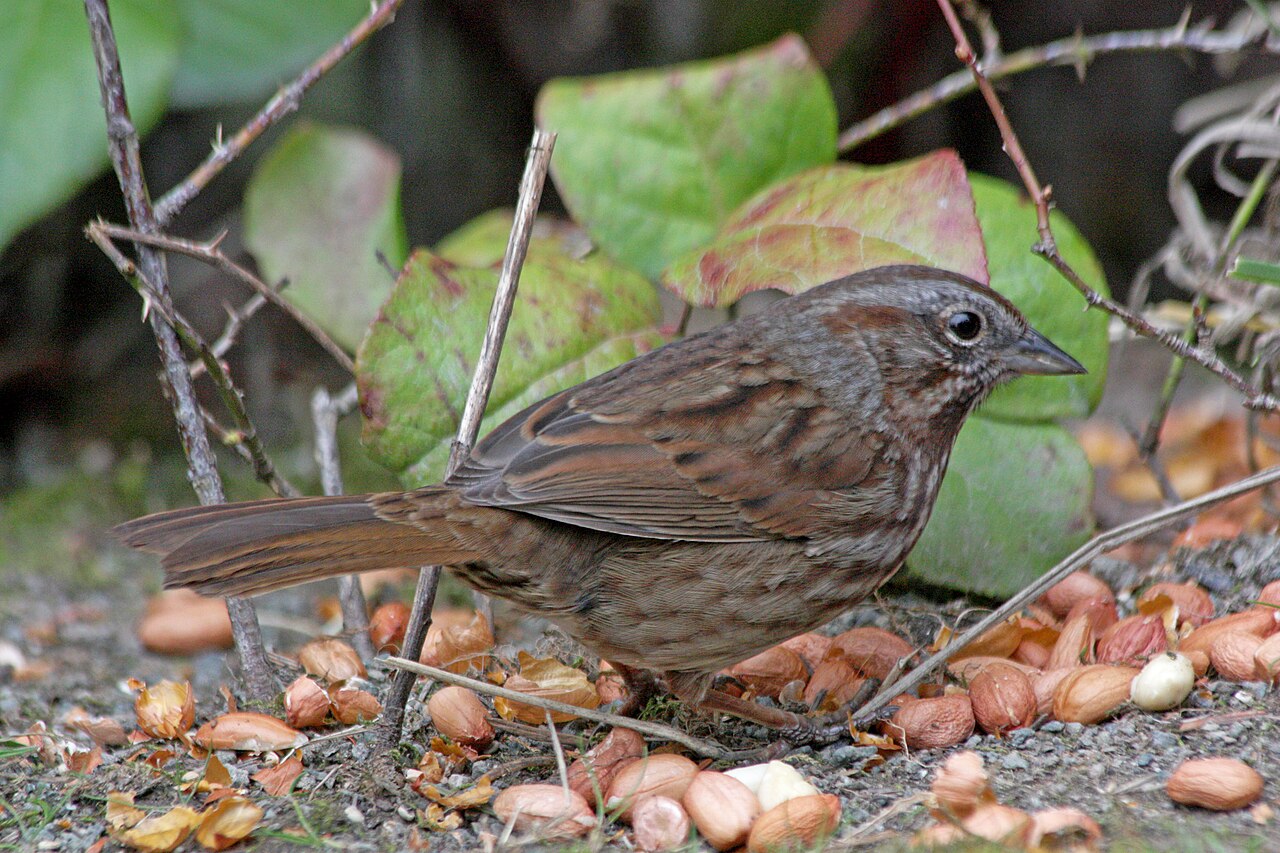
Some New Year's Day I may fling open the curtains to find a crested oropendola, a hyacinth visorbearer, or some other spectacularly unlikely bird at the feeder to claim as my first bird of the year. But I'm not holding my breath. I wasn't at all surprised to be greeted by one of North America's most common and widespread birds: the plain-Jane-simple-name Song Sparrow.

The song sparrow is one of the many little birds in the group known as LBJs ("little brown jobs"--a.k.a. LBBs, "little brown birds"). It is found throughout much of North America.

"Common and widespread," states the Kaufman field guide about this species. "Common and widespread," agrees the Sibley guide. "Probably the most widespread sparrow," adds the National Geographic guide, nodding eagerly.

But looks can be deceiving, because this ubiquitous little brown bird actually varies widely in coloration across its range.

Photo courtesy BLM (song sparrow, Alaska)
Song sparrows in the desert southwest, for example, are pale reddish yellow birds, while song sparrows in Alaska's Aleutian Islands wear dark feathers and are a third bigger than their cousins in the eastern United States. There are reddish brown song sparrows in some places, birds with slate-gray backs in others.

This variation is so bewildering that the Peterson field guide waves its hands wildly and warns with a note of panic, "Do not attempt to untangle various migrants in the field."

(Don't worry, though, if you have recklessly attempted to untangle various migrants in the field. The Cornell Lab of Ornithology's song-sparrow profile reassuringly advises, "Don’t let the bewildering variety of regional differences this bird shows across North America deter you: it’s one of the first species you should suspect if you see a streaky sparrow in an open, shrubby, or wet area.")

Photo from Wiki Commons
Song sparrows are a cinch to identify in the garden right outside your kitchen window, though.

Here in Washington State, song sparrows are chunky, dark-feathered birds with boldly streaked breasts that bear a characteristic central spot. They're just as much at home in a well-planted garden as they are in their natural habitat of low, thick brush; a 1968 Seattle Audubon Society publication calls this species "the 'small brown sparrow' of backyards, brushy areas, and semi-open woods."

In winter, our yard's song sparrows often show up two at a time. They usually hop about under the feeder, eating seeds spilled by the enthusiastic finches and chickadees clinging to the feeder's wire mesh. There on the ground, they keep company with several spotted towhees, a varied thrush, and an occasional fox sparrow.

Come spring, we'll hardly see them at all, partly because we've shut down the feeder  but also because song sparrows are busily courting, defending territory, building nests, and feeding hatchlings. But we will hear them caroling from dawn to dusk as they prove they're not called "song" sparrows for nothing.

For this plain little brown bird is a vigorous and lovely singer. One of its regional common names is "silver-tongue." Even its scientific name honors its ability: Melospiza melodia means "Song-finch song."

Photo from Wiki Commons
I used to hear song sparrows trilling in the birches of my childhood Long Island, New York, suburban home. So many sparrows sang that they sounded as if they were doing a call and response routine. It was a joy to hear their familiar melody welcome springtime when I left  New York and moved to Seattle 25 years ago.

A song sparrow's song isn't the complex river of sound that flows from the minute Pacific wren, or the ethereal cry that spirals from a veery or Swainson's thrush--it's more of a confident, burbling, cheerful, chatty sort of tune.

First the little bird pipes three times, as if warming up or calling its listeners to attention. Then it trills loudly before descending into a quickly uttered series of chirps and ringings.

As a kid I always thought it sounded as if the sparrow were contentedly talking to itself after it had emitted the pipes and trills.

Ornithologist William Leon Dawson (1873–1928) called the song sparrow "the poet of common day" and described its melody as being "like sunshine, bountiful and free and ever grateful." He transcribed the sound as peace, peace, peace be unto you, my children.

Of the song sparrow's song, Audubon wrote:
"I have at all times been very partial  to the
Song Sparrow; for although its attire is
exceedingly plain, it is pleasing, to hear it,
in the Middle States, singing, earlier in
spring, and later in autumn, than almost
any other bird. Its song is sweet,
of considerable duration, and performed
at all hours of the day."
A more common mnemonic device for identifying the aria of a song sparrow hidden among leaves and brush is Madge, Madge, Madge, put on your tea kettle, kettle, kettle or Maids! Maids! Maids! Hang up your teakettle-ettle-ettle!

The Audubon Society's massive Encyclopedia of North American Birds adds that the "first three notes [are] often popularly compared with first three notes of Beethoven's Fifth Symphony."

The male repeats this song frequently, as often as eight times per minute, and though he sounds jaunty there's serious stuff at stake: he's defending his territory and also seeking to attract a mate.

According to the Cornell Lab of Ornithology's profile of the song sparrow, "Laboratory studies have shown that the female Song Sparrow is attracted not just to the song itself, but to how well it reflects the ability of the male to learn. Males that used more learned components in their songs and that better matched their song tutors (the adult bird they learned their songs from) were preferred."

Fortunately, human listeners don't have to be so picky. We can simply enjoy the glad tidings of spring from a little brown bird, common and widespread, that is known in some parts as "everybody's darling."


Monday, December 29, 2014

A Year of Skies

My father often said that he felt no need to go on vacation since moving to the Northwest--that just watching the sky change on some days was like going on holiday. So as 2014 sinks below the horizon, here are some of the lovely skies we've seen in recent years. Happy 2015!


Saturday, December 13, 2014

Pony Books and the Making of a Reader

Photo courtesy Newspix/Rex Features

A few months ago there was a dust-up online regarding adults who like reading YA literature.

Apparently this twisted the knickers of some critics, who muttered about the quality and (supposed) lack of depth in YA literature.

Reading the Harry Potter books, anything by John Green, and the like was suddenly a shameful thing for adults to be doing, though I guess it was OK to read chick-lit or light beach-escape reading as long as it was written with grown-ups in mind.

Far better writers than I have addressed this issue and extolled the fine writing and substance to be found not only in YA but also chapter books and picture books. I can only say that I've had a very pleasant few months indulging in the habit of reading horse books, which took turns with other novels that would be more likely to pass muster with these critics.

As a horse-crazy kid, of course, I did nothing but read horse books between the ages of 9 and 14. My local library helpfully labeled all its horse books with a little horse-head sticker on the spine, so you didn't even have to use the card catalog.

I figured I'd probably read every horse book available in our library system and most of the ones ever written for the middle-grade/young adult crowd by the time I got to high school, but there were actually herds and herds of literary oaters out there that I'd never come across, and that's not even counting the hundreds of titles that kids in England enjoyed throughout the 1900s.

Among these titles was a five-book series I stumbled upon in a vintage-items shop in late summer: The Timber Trail Riders. This series was published between 1963 and 1964, when I was still a very tiny person learning to talk, let alone read.

The adventures of the Timber Trail Riders were published by Whitman Publishing Company of Racine, Wisconsin. Whitman Publishing Company became a subsidiary of Western Publishing in 1915 (Western later published the beloved Little Golden Books). The Whitman line included many mysteries and westerns; series based on characters such as Trixie Belden, Donna Parker, and Troy Nesbit; and many books based on popular TV shows and movies such as Lassie and various Walt Disney films.

One aspect that intrigued me about these books was their obvious appeal to boys--three of the five stories featured boys as the main characters. This might not have been remarkable back in the day, but among the connoisseurs of pony books (yes, there is such a thing, and we hold our heads high), there is concern about the pinkification of the horse world--is there too much emphasis on all that is pink, glittery, and princess-y?

When the Resident Teen was a very small Resident Horse-Crazy Tot, a friend who was the mom of a little boy told me her son had rebelled at the idea of visiting some horses while they were on vacation. "Horses are girrrrl animals," he sneered, wrinkling his face in disgust. (Interestingly, in his middle teen years, this boy became a Brony.)

There was no shortage of boy-friendly horse stories when I was looking for books in the 1960s and early '70s, though. Marguerite Henry's books appealed to both boys and girls, as did the many volumes in Walter Farley's "Black Stallion" series. Most of these books had boys as the central human characters, but the horses figured so strongly in them, it wasn't off-putting to a horse-crazy girl reader.

I read Henry's books over and over, though the Black Stallion books didn't grab me--I read a few of them and then left off when my mom signed me up for the World Famous Horse Story Library book club, which brought books from authors around the world to my doorstep.

So when I sat down to read the Timber Trail Riders, I wondered if they'd have appealed to me when I was a kid, when just about all it took for me to like a book was the presence of a horse every few paragraphs.

When I finished them, I knew for sure they wouldn't have been my cup of tea.

 Not because the writing is terrible--it's not scintillating prose, but it's up to the task for a simple, unadorned, straightforward action-adventure mystery, perhaps the sort of writing for teens that would be called "hi-lo" today (high interest/low reading level).

One reason I wouldn't have liked them is the fact that they're mysteries. I hated mysteries as a child and I still don't like them. I had only one mystery book as a kid, and the only reason I read it again and again was because I knew how it ended. Something involving--wait for this--a false drawer in a desk! Unheard of!

I also wasn't, and am still not, really interested in fast-paced adventures. I couldn't have said so at the time, but the fact that as an adult one of my favorite books is The Sound of a Wild Snail Eating by Elisabeth Tova Bailey is a pretty good clue that this taste in reading has deep roots. (The book chronicles the long, slow recovery of the author from an obscure virus and her observations of the tiny snail that lives in a potted violet on a table by her bedside.)

My childhood obsession with horses taxed the patience of many adults--an art teacher took credit off my grade because I painted too many horses, a great-uncle ridiculed my drawings because they were of "yet another horse," and I was praised mightily when I brought home a book from the library that wasn't about horses.

(I often wonder if kids who were interested in cars, rockets, stamps, ancient Egypt, or the like were pressed to set aside their interests in this way.)

But I can say only this to teachers and parents who fear that girls' horse obsessions will limit them in life: Stop worrying. Horses carry the young reader into all kinds of amazing worlds of imagination and history and fact. And I can see now that the types of books I like now are rooted in those horsy books I indulged in as a kid, so I was actually forming reading tastes while I was steeping myself in horse lore. Jill Crewe of Ruby Ferguson's "Jill" pony books and her stories set in a small village where everybody knows each other, life turns on small hinges, and there's lots of talking and humor? Well, Jill, meet Jane Austen.

OK, So, What About the Books?

As noted, there are five titles, all published in a two-year span. I have found very little about them on the internet and absolutely nothing about the author. Or authors? Was Michael Murray a pen name for several writers? A copyright-renewal page online notes only that Murray was a hired writer. Either Murray was a very fast writer, or he was actually two or three writers.

I also wondered whether Whitman intended to continue the series. Each book's cover includes the title and a tagline featuring the main character's name: "A Mike Casey Story," "A Peggy Lewis Story," and the like. This billing makes me think they thought the series would take off and that the characters would become household names.

What they have in common is a scheme used by authors from the Brothers Grimm to Roald Dahl and J. K. Rowling: get rid of the parents, and get rid of them quick!

Fortunately for the parents of the assorted Timber Trail Riders, most of them are not stomped to death by an angry rhinoceros, blasted by an evil wizard lord, or otherwise dispatched. Typically, the kids simply get a marvelous opportunity to live away from their family for a month or two or even as long as a year and have thrilling adventures during that time. They also obtain horses or access to horses in ways that real kids can only dream of. Details below.

The Long Trail North: A Mike Casey Story

Mike Casey and Danny Hall are 13-year-old boys who help out on an old-time cattle drive set in modern times. It's all part of a nostalgic whim of an Englishman who’s bought an old cattle ranch that other people wanted to turn into a game farm. Failing to obtain the ranch (spoiler alert), the bad guys try to sabotage the cattle drive.

Little hiccups in the journey include  a near drowning, a few stampedes, a steady loss of cattle, and a hostage situation in a ghost town.

A fun surprise in this book is the appearance of a Native American boy who's also coming along as a drover. Mike speaks to him in stupid, truncated English, saying things like "We come from east, far toward rising sun.”

Little Bear plays along for a while, until he's asked if  he's ever heard of Chicago. He replies, “If you’re referring to Chicago, Illinois, I’ve been there at least half a dozen times, visiting my uncle who teaches ethnology at the university. I presume that is the Chicago you have reference to?”

The Texas Tenderfoot: A Dave Talbot Story

Dave Talbot, age 15, arrives in Chicago’s airport, dressed like a cowboy, and gets stared at a lot. Dad is off for a year working in the oil industry and Mom is deceased, so Dave's going to stay with Dad’s old pal  Colonel Dwyer who owns a big horse farm,. There he meets mysterious Lee Ann Burton, a poor little rich girl whose jet-setting parents are out of the picture.

They contend with Bo, the mean stableboy who's up to no good. You know he's Trouble with a capital T from the start: "“Bo was a husky tanned youth, with heavy features and a sullen manner. His dark brown hair had streaks of yellow, and he wore it too long, with slicked-back sides and exaggerated sideburns.”

Long hair--and dyed, no less! Clearly bad news.

Dave falls off a horse that Bo deliberately saddles improperly. Bo also lets valuable horses escape and tries to blame it on Dave, puts a burr under his saddle, and even attempts to burn down the stable. Dave ends up playing Sherlock Holmes and proving Bo's the culprit. In other news, Dad buys the brilliant horse Star Bright for Dave. There's also a show and party. The author of this book describes all the food lavishly. It will make you hungry.

The Luck of Black Diamond: A Sunny Saunders Story
Sunny Saunders is a young teen who goes off to live with her aunt and grandmother for a few weeks in Colorado. Straightaway she is witness to the rescue of a cow that gets stuck in quicksand. Soon after she is given free use of a splendid black horse named Diamond, who is getting a month off from his job as a regular lesson horse—he will be hers alone.

And then her uncle buys the horse to send home with Sunny, on the condition that she ride him and not neglect him. Which causes her to worry mightily about her magnanimous decision later on to let her friend ride the dependable horse in a show—her uncle has arrived for a surprise visit and when he sees that, he’ll hit the roof, won’t he? No, because at the last minute the other girl gets another lovely horse and all is well.

This, the third book in the series, appears to have been written deliberately to cater to the tastes of many girl readers by focusing on relationships rather than adventures (a stereotype, for sure, but it probably resonates for a lot of women who like romances). After the quicksand bout, there are no other big adventures than a snarly dog that sometimes frightens the riders as they trot by a house.

One aspect of this book that I liked was how Black Diamond is actually endowed with a lot of personality--he's got opinions and quirks. However, I didn't appreciate the stunning lack of sympathy for a girl in the story who's afraid to ride after a fall—she’s repeatedly told she's “silly.” The book is also, of course, a product of its time, which still doesn't stop you from bridling when you read that when Sunny hugs her horse and he objects, Sunny concludes, “He was not like a girl, pleased to be kissed just because some boy wanted to. His favors had to be won.”

The Mystery of the Hollywood Horse: A Peggy Lewis Story

Teenager Peggy Lewis heads off to California to stay with her Aunt Paula for a month. Her aunt finesses a job for her at the stable of the trainer of Cinder, famous TV-star horse. She soon becomes friends with the girl who’s starring in Cinder’s next movie.

There’s also a mysterious, grumpy older teen named Chuck who skulks around fretting about Cinder. They find lots of clues that point to somebody plotting to steal Cinder, and speculate a lot about it and whether or not to tell his owner for fear of being dismissed as worrywarts and fussbudgets. Guess what! Cinder gets stolen! Peggy, however, finds the horse thieves’ secret lair and spirits the horse out. The police show up and the bad guys are caught.

This story stars a girl, and has more in the way of "relationship" angst than the adventure-oriented tales even though it has more hijinks than Sunny Saunders's story, but I did grow weary of all the hand-wringing and keeping things silent. Perhaps just my frustration with mysteries showing through. Or else knowing that the darn horse would be stolen and wanting to head this off at the pass.


The Mysterious Dude: A Dave Talbot Story

Dave Talbot reappears in this book. He arrives at the California dude ranch of one of his dad’s friends. Dave and that man’s son, Ron, were childhood friends. Ron's parents, Mr. and Mrs. Maynard, have to go East because Mrs. Maynard suffers from some mysterious illness, and she will get examinations there.

Because they're gone, the ranch may have to be sold—but no! Ron and Dave will run it in their absence!

Mystery shows up in the form of a slight girl with a “pale” voice who corrects everybody and recites information like a machine. She's annoying as heck and does irritating things like take horses out of the stable in the middle of the night. But I have to say she's a weird and interesting twist on your typical horse-book character.

Unfortunately, unlike the tongue-in-cheek and fairly respectful portrayal of a Native American teenager in the series' first book, this title includes a Mexican cook who's a hot-headed, fiery South-of-the-Border stereotype straight out of central casting; she flings pots and pans and mutilated English right and left, and has a son who speaks like the mouse Speedy Gonzales from the "Bugs Bunny" cartoons. Kind of cringe-inducing.

Later on, it's revealed that the Mysterious Dude-ette has a photographic memory. Not only that, but she turns out to have witnessed a crime and is hiding out at the ranch to escape a trio of men who are aiming to snuff her out, which they attempt to do during the big parade before the rodeo.

I have to admit that by this time I was weary of action-adventure and mystery, and eager to get back to reading Molly Gloss's Falling from Horses, so I was rather racing through the books at the end. It did feel nicely subversive, however, to read books that the "no teen lit for adults" leagues would've chided me for perusing.