Pages

Tuesday, March 12, 2013

The Garden Awakes, Slowly

Vinca flower and leaves
I ventured out into the garden this past weekend to do more than just (a) throw a ball for the dog, (b) throw a green plastic dinosaur for the dog, (c) throw an orange plastic fish for the dog, or (d) clean up after the dog. Saturday was sunny and warm, Sunday was gray but fairly dry--a good weekend to start poking at the garden to see if it was ready to get up.

Of course, the garden was both way ahead of me and on its own schedule. Things were stirring and had been for weeks. Vinca flowers have blinked on like purple stars in a galaxy seen only by day. Snails are skating across wet leaves and paving stones. The yellow pompoms of kerria have bloomed on the topmost branches. The branches themselves are still without leaves, so the shrub looks a bit like it's marching off to clean some floors, with mops tossed over its shoulder.

Spirea leaves unfolding
My main task was to shift one of the two raised planting beds west by three feet. This may sound rather pointless, and certainly if you are a farmer with acres and acres to till it probably sounds silly, like something you'd accomplish while the coffee brews.

But for this city slicker it was a Morning's Work because it involved a shovel. And digging. And tossing the dirt into a pile. And levering the wooden box up and out of the soil and shifting it.

The two boxes were separated by three feet in the first place as an accommodation to the resident teen, who at the time of their building was still the resident elementary-school-aged child. She protested the building of planting beds in the garden because how, then, could she possibly continue to build jumps and hold gymkhanas in which she was both horse and rider?

She resisted our arguments that, now that we had a dog whose claws tore up the so-called lawn (which had always been a fragile and temporary thing) and churned the yard to mud, we needed to cover up the space with something other than grass. So we accommodated the horse shows by leaving an avenue between the beds and around them, which actually contributed to the setup of cavaletti, oxers, brush fences, and in-and-outs.

Nowadays, as you might guess, the resident teen no longer canters around the garden crying "Tally-ho." And the shrubs to the east of the raised beds have encroached on the sunlight falling on the bed being moved. Hence the digging and shifting.

"Go away and let us sleep."
As I hefted paving stones and dirt, I came across lots of critters who were still snug in their winter beds and none too pleased to be disturbed.

Worms managed to radiate great irritation despite being extremely simple creatures who have ganglia but no brain. (According to one science education site, "They have no brain...so worms do not ponder their lowly lot in life.")

Presumably these worms had some more non-pondering to do before getting busy with springtime chores such as Tilling the Soil, so I made sure to bury them again if I dug them up or place dirt over them if I'd removed their paving-stone roof.

There was also a grumpy millipede living in a miniature cave just below the edge of the wooden frame. It sorted out its legs, scuffling around for its many bedroom slippers, before trudging out of sight into a tunnel. Just down the block from the millipede, a centipede was startled out of hiding. The carnivorous centipede didn't seem as lethargic as its vegetarian neighbor, but it still acted as if it were looking for a ringing alarm clock in a panic, desperate to shut it off.

It tried to climb out of the hole I'd dug for the corner leg of the raised bed. I helped it out (with a stick, as centipedes bite) and set it in a safe place, only to see it run around like crazy and fall back into the hole.

When I lifted up a paving stone that had been leaning against a stone, I found a snail deep in slumber as well as a tiny, round orange insect that appears to be the nymph of a plant-eating true bug of some sort.
Unfortunately, moving the stone had scraped off a portion of a puffy white egg sac attached to the underside. It was filled with small yellow eggs.  


A spider rushed across the stone, lingering long enough for me to take a fuzzy picture, but not long enough for me to see if it had anything to do with the egg sac.

Not being an arachnologist, I can't determine what kind of spider it is, but looking online, it seems as if it might be a Tegenaria species, one of the funnel-web weavers (related to the dreaded hobo spider). But I could be, and probably am, wrong.


The sleepy minibeasts' inactivity was more than offset by the busyness of ants, those "little creatures who run the world" in the words of E.O. Wilson. 

They didn't seem to be much upset by all the earth-moving; they acted more like curious onlookers who were pleased to see other living things moving dirt as they did and possibly commenting on the digger's methods and strategy.

The one below posed most obligingly on a pebble. (A pebble, in my world; a boulder in the ant's.)


Lovable Labrador Luna liked the digging action, too, and especially liked standing in the garden bed, from which she is usually shooed. I looked up at her at one point and wondered why she was standing with her head all tucked in and brow furrowed.


Upon closer inspection, I saw that she was nose to nose with an ant. I was surprised that she could even see the little insect and even more surprised that she didn't slurp it up. As for the ant, I can only imagine what it must be like to suddenly have the equivalent twin horrors of the Lincoln Tunnel and Hurricane Sandy appear before you.

Tuesday, March 5, 2013

Stupid Turnips

"I'm a GOOD turnip farmer."
There's a famous scene in Gone With the Wind in which Scarlett O'Hara gnaws on a turnip ripped from the soil, gets sick, then rails at the heavens, "As God is my witness, I'll never go hungry again!" Turnips proceed to sustain Scarlett and her family during those first tough years bringing Tara back to life.

Well. Scarlett would have gone very, very hungry indeed if she'd been relying on our turnip crop.
Turnips are supposed to be fairly easy to grow. So trouble-free that they're used for feeding pigs and cattle.

According to one farm's website (whose testimony I don't doubt, as they actually successfully grow crops), "Turnips require very little care, tolerate a wide range of soils and positively thrive in cold temperatures. "  


What turnips SHOULD look like.
The Seattle Times gardening column lists it as a standard winter crop. "Turnips are frost-hardy and like cool weather!" warbles Sunset Vegetable Gardening. "Where winters are mild, plant in fall for a winter crop," assures the Western Garden Book, adding that the plants need "ample space for root to reach full weight of 3-5 lbs."

I don't think our entire turnip crop registered 3 to 5 pounds in weight, though possibly it would've achieved this heady status if I'd weighed it before cutting off the greens, wiping off the slugs, and washing off the dirt.

In fact, it looked as if all the turnips had taken a vote and decided that just one of them would grow to anything like normal-turnip size, while the rest of them would remain little.

"I'll do the growin' around here, and don't you forget it."
Not only were most of them just cruciferous Ping-Pong balls, they were also riddled with tunnels. And a pillbug was cozily residing in one of them. Could the culprits be root maggots?

According to a gardening advice column in The Seattle Times, "Root maggots overwinter in the soil as larvae and pupate near the surface of the soil in the spring, using root crops like turnips for sustenance."

If they're pupating, they wouldn't be eating, and when they emerge from their pupae they'd be full-grown flies and wouldn't be gnawing roots, either, so they have to be talking about the larvae (which is what maggots are, after all).

Canadian Organic Growers notes cheerfully that "winter turnips or rutabagas are riddled by the maggots but only superficially at the bottom of the root which can be trimmed off at harvest," so I thought maybe the rotten little creatures were busy very early in the mild winter season.


Now I'm wondering if it was just our old familiar slugs rasping away at them. The University of Maryland Extension website chronicles the hollowing-out of turnips by young slugs here and notes "If your turnip crop yields stunted, hollow turnips...don’t overlook the possibility that slugs have found and adopted your turnip roots as near perfect places to live."

Though why the turnips stopped growing is a puzzler to me. Then again, I guess I wouldn't have much motivation, either, if I'd been gnawed by maggots or slugs.

Oh well. We'll get one pan of roasted turnips out of the lot, anyway (after having composted the heavily damaged ones). And the leeks did astonishingly well --the p-patch is a veritable old-growth forest of leeks. Too bad we haven't figured out a dish we like them in all that much...maybe we'll just use them as inspiration for writing and pen an ode to "Spring: A Leek."

Thursday, February 28, 2013

Yes, That IS a String of Cheetos Hanging From the Eaves. It's SCIENCE.

Let it not be said that the residents of our household do not have Inquiring Minds. Science: It's what's for breakfast. And for sleepover snackses.

For the past three weeks we've had a rain-chain of Cheetos hanging from the front eave of the house. It was draped there by a gaggle of girls whom the Resident Teen had invited over for a sleepover (though to be precise it was more of a movie-over, or a feast-over, or something, with  lots of texting mixed in). 

It came to my attention when I wandered into the living room, which was momentarily the only quiet place in the house, and saw this weird apparition bobbing outside the window, backlit by the streetlights. 

Amazing, how quickly the brain works: "What is THAT? Oh, of course. It's Cheetos tied to a string. Suspended from the eave."

A request was made not to disturb the Cheeto-chain because the science squad wanted to see how long it would take for birds to eat the snacks. Sure, fine, whatever. 

(Never mind that I can cause my offspring terrible embarrassment merely by being seen at school, or by breathing too loudly, or by blinking too rapidly. Apparently decorating one's house with snack foods is perfectly acceptable.)

I assumed the crows would make off with the cheese puffs in no time. I've seen them wolfing down Cheetos in parks and playgrounds, after all, and here they were getting them served up virtually on a silver platter. Barring that, the little orange squiggles would surely grow moldy and disintegrate. (Talk about shabby-chic decor for your home!)

Well, that was the hypothesis. Much to our surprise, the crows did not gobble up the experiment. Nor did the snacks grow moldy. They lost volume as they dried out (the Resident Teen noted that they'd gotten pretty tough), and didn't regain any size even when they grew spongy with rain. 

Get thee behind me, Doodles!
Otherwise, I think they may have persisted in the environment for a very, very long time (except that the teenage scientist finally and unceremoniously yanked the Cheeto-chain off the house and threw it away). The secret to eternal life probably lies in the preservatives used to ensure a long shelf life for cheese puffs. 

OK, I know full well that snack foods like this are the opposite of kale chips. I have come a long way from craving the Cheez Doodles I loved so much as a kid. 

And I know that one should be suspicious of foods that come in bags that warn you to keep them out of the light. (I can't recall what brand of cheesy snacks required darkness--or should I say "cheezy snax," as weird spelling seems to be required when describing cheese-flavored cornmeal puffs).

But don't let a bag of them anywhere near me because I can still hear their siren song....

Curious to find out more about the latest in cheese-puff science, I went a-Googlin', and was newly amazed by the creative capacity of my fellow human beings (and in some cases astonished by just how much time can be wasted, and--to go for a trifecta of adjectives beginning with A--appalled by  just how bad bad taste can be, and we're not talking about the taste of the cheese puffs).

This is a cheetah, not a Cheeto. Couresty Wikipedia.
There is a blog that covers an entire summer's worth of Cheeto science experimentation. You can find out just what's in a Cheeto here. There are people who make artworks out of Cheetos: one woman made an entire Cheeto room complete with furniture and people, and another artist uses that neon orange dust that collects at the bottom of a Cheetos bag to make portraits, such as a cheesy one of Elvis on black velvet. There are teachers who have little children eat Cheetos in order to teach them about pollination. (I kid you not. I suppose the next unit in their science classes is Nutrition.)

There are also lots of chickens, corn snakes, orange-tabby cats, hamsters, and other animals named Cheeto. (I have even personally met one of these animals, and  he is said to be a good rat-catcher.) 

Other fun cheese-puff facts for those seeking to snack on junk-food trivia: 

Cheese puffs were apparently discovered by accident in the 1930s as a worker making flaked corn for cattle feed noticed that damp cornmeal heated by a flaking machine's motor caused the cornmeal to be extruded in long threads. Add flavoring to extruded, damp, warm cattle feed, and voila! A snack sensation is born!

Cheetos were the first American snack food to be produced and distributed in China (in 1994). According to Wikipedia, taste tests were performed first, with "ranch dressing, North Sea crab, smoked octopus and caramel being passed up for two flavors: Savory American Cream and Zesty Japanese Steak."

Django watched the Cheeto-chain for HOURS.
Wise snack-food company makes cheese puffs that look like crocodiles.

There are apparently people who will pay $35.18 to purchase Cheetos on ebay that purport to resemble Michael Jackson  moonwalking.

Wotsits are the UK's version of cheese puffs, and you can get them in prawn-cocktail flavor. They also once made a product called "Mealtime Potato Shapes," which shows that they really desperately needed a marketing department.

Right, that's quite enough of that. Onward. What science projects do you have hanging around your house, literally or figuratively (not counting the ones we all have lurking in the back of the refrigerator in mysterious food-storage containers)?


Friday, February 22, 2013

Gray Days and Braying Jays

There are many East Coast birds that I miss a great deal even after a quarter-century of living in the Pacific Northwest.

Among them are cardinals,  with their blood-red feathers; mockingbirds, who somersault from TV aerials while belting out a medley of Top-40 birdsongs; brown thrashers, strutting like rusty peacocks across the lawn;  common grackles with their uncommonly iridescent feathers glistening purple and green; blue jays crisply decked out in cobalt and white with black trim.

Not that we're lacking for nice birds in this part of the world; varied thrushes, Pacific wrens, and chestnut-backed chickadees aren't too shabby, after all. But none of these show up regularly in my garden, whereas those East Coast birds practically lined the window ledges of my split-level childhood home.
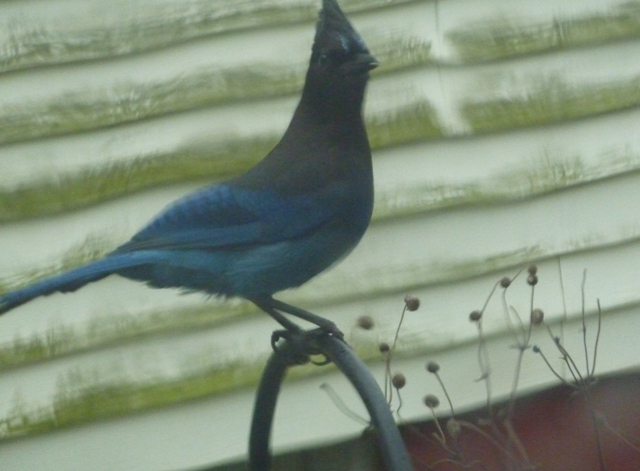
The Steller's Jay who suddenly discovered our feeders.

So I was pretty pleased when Steller's Jays turned up in my area a few years ago, though I am fairly certain that this isn't the prevailing opinion in the neighborhood. Steller's Jays are nearly crow-sized birds that wear blue body feathers with a cape and crest of black. They're very attractive--but also very noisy and assertive.

The fact that they rob other birds' nests and eat the eggs and young uncomfortably suggests that their garb is an executioner's hood, though of course they're just trying to survive like any other animal. Still, it's not a habit that warms people's hearts.

They are birds of coniferous forests (of which there's no shortage in Washington), so the local ones tend to hang out in the neighborhood's tallest evergreens. They scream, squawk, and rattle as they trade catcalls wtih the crows.
Steller's Jay in our backyard birch tree.
Field guides devote a lot of space to the jays' raucous vocabulary: the Audubon field guide says they scream shack-shack-shack and chook-chook-chook; Kaufman's guide describes it as kessh, kesssh, and shek-shek-shek; Sibley hears shek shek shek shek but also shaaaaar (give or take an a). A 1968 Seattle Audubon bird guide agrees about shack shack shack but also catches a flitch-flitch-flitch in the cacaphony.

William Leon Dawson, writing in 1923, says the bird's cries are "harsh and expletive," noting that "Shaack, shaack, shaack is a common (and most exasperating) form," though he also acknowledges the jay sometimes emits a "mellow klook, klook, klook."

But it's Wikipedia (not a reliable resource but often fun to consult) that seems to get the greatest kick out of the jay's language. "One common call is a harsh SHACK-Sheck-sheck-sheck-sheck-sheck series; another skreeka! skreeka! call sounds almost exactly like an old-fashioned pump handle; yet another is a soft, breathy hoodle hoodle whistle. Its alarm call is a harsh, nasal wah....Some calls are sex-specific: females produce a rattling sound, while males make a high-pitched gleep gleep."

Every source cites the jay's ability to imitate a red-tailed hawk. A few claim the jay impersonates the hawk in order to frighten smaller birds away from food sources, but having seen how quickly a big jay blustering up to the bird feeder can disperse a flock of sparrows, I doubt it really needs to play vocal tricks to get what it wants. Like crows, ravens, and other corvids, jays are simply excellent mimics; Steller's jays have been heard borrowing the sounds of squirrels, dogs, chickens, and other animals. (I once heard a crow in a Grand Canyon campground do an excellent imitation of human snoring.)

Though the jay's shrieking and rasping probably sounds like nails on a blackboard to most people, it's a useful barrage for birds and other animals in the wild. The Steller's Jay is a very alert sentinel. Dawson notes that "to do him justice, it is usually the Steller Jay who is first to make discovery and outcry if there is any mischief afoot in the woods."

The jay's policing of the forest was also noted by Thomas Nuttall, a contemporary and fellow naturalist of John James Audubon. Audubon painted the jay, but in describing the bird quoted extensively from Nuttall, who reported that jays are "watchful as dogs" and that "a stranger no sooner shews himself in their vicinity than they neglect all other employment to come round, follow, peep at and scold him, sometimes with such pertinacity and irritability as to provoke the sportsman intent on other game to level his gun against them in mere retaliation."

He adds, "At other times, stimulated by mere curiosity, they will be observed to follow you in perfect silence, until something arouses their ready ire, when the djay, djay, pay, pay, is poured upon you without intermission, till you are beyond their view. So intent are they on vociferating, that it is not uncommon to hear them busily scolding even while engaged with a large acorn in the mouth."

Audubon also repeats information from naturalist John Kirk Townsend, who told him that the Chinook Indians called the bird "Ass-ass" (as I am sure some householders trying to sleep in on a Saturday might likewise be inclined to grumble with full Anglo-Saxon meaning intact). He went on to claim that the Chinook "regard it with a superstitious feeling, believing that should a person hear it enunciating certain notes, which resemble the syllables jaa-jaa, he will shortly die, whereas its other notes, kuc, kuc, kuc, kuc, rapidly repeated, portend good."

Uh-oh! Mr. Jay has spotted me through the window.

I must admit that I wasn't exactly thrilled to have this jay arrive at the feeder--he's a bit of a hog, and certainly cleared out the restaurant of all other customers, including the hummingbird. And I remember how one of his kind woke us up at the break of dawn on a camping trip when it invaded the nest of a cheerful family of sparrows living in a shrub beside our tent. Still, it's pretty cool to have such a big, rowdy, flamboyant bird brashly swaggering around in one's soggy, gray-green winter garden. If you can't have cardinals, that is.

Tuesday, February 19, 2013

Heartfelt Art Felt Oregon Onion

Today's post is written by a guest blogger, Bria Onion, who came home with me from a trip to Oregon this weekend.

Hello. My name is Bria Onion. I sprout from Eugene, Oregon. 

At least, that was my previous stop en route from the Felty World of Eliel's Felties. With the help of Eliel, some sharp needles, and loads of woolly roving (thanks, sheep!), I came into being.

I left behind my felty friends (assorted flying pigs, asparagus spears, rabbits, plesiosaurs, penguins, and more) to come north to Seattle.

I traveled inside a shoe, which seemed made to order for my shape and size.

The shoe was inside a bag, which was inside a train.

So I guess I actually traveled inside a lot of things. We onions do like layers.

Being an onion, I did shed a few tears.


But I quickly recovered.

Then I said hello to the family dog.  This was a very brief hello.

I didn't want the dog to get any funny ideas, because, after all, I am a bit fuzzy like a tennis ball.

At first, I was a little lost, because I'm used to being surrounded by other Felties.

But this feeling didn't last for long. 
In the kitchen, I was immediately welcomed by a small pumpkin and a Valentine cookie, so I soon felt at home.

Now I'm happily ensconced on a shelf quite out of reach of the cats, where I have very pleasant chats with a little Yellowstone-souvenir bear in a crate from the 1930s and a stuffed polka-dotted flying squirrel. As you can imagine, they have a lot of stories to share. 

My backstory includes a stint as a placeholder in books, so I'm looking forward to delving into some new titles here.

My reading list includes "The Black Scallion," "The Time of Our Chives," Steinbeck's "The Pearl Onion," and the classic E. B. White story "Shallot's Web."

Oh, and "The Onion," of course.

I'm looking forward to meeting the felted pincushion who my new friends say lives elsewhere in the house. Cheers!


Wednesday, February 13, 2013

Happy Valentine's Day...That's All


Valentine's Day Roses from a past year
Luna Lovedog, birthday Feb. 14, Superhero

Heart of a Dianthus flower, spring 2012
Roses, neighborhood steps, 2011
Django the Art Cat, with 'heartwork' in bowl, date unknown
   
Yours truly, Valentine's Day dress, 1967

Monday, February 4, 2013

In Memoriam


In Memory of Maia H.
February 3, 1989-January 27, 2013
beloved daughter of a dear friend
untimely ripped from this world

"Nothing fine will ever perish 
as long as there are hearts to remember."
--Kate Seredy, The Chestry Oak